Showing posts with label Maine Indians. Show all posts

Thursday, June 9, 2016

The Coming and Going. Of Design. - Part Two


The Coming and Going.

Of Design.

Part Two


            It is easy, once denoted, to practice, polish, perform and ‘Piccadilly’ (the English influence upon old New England design) domestic waste paper basket design... in the old New England home and
            Its imitators.
            Once one is ...sensible... about that (waste paper basket design):  Just look around, after entering the home, for their waste paper baskets and one will...  “ahhhh....” “see them”.  Or not.
            Or what.
            Or “those?”
            And, of course... “oh no”.
Do I care if you toss your nose drip soaked Kleenex into a ‘that’?
            No.
            I do denote the ‘that’ and do, there after, ‘carry on’.  I do not have to ‘remain calm’ for... “WHY?” would I become excited or panicked over ‘obviously bad taste’ in waste paper baskets?  Those sign posts assure me that it is, simply, ‘worse from there’.  When I am in a home, usually upon the “look around” “please” ritual, I notice if the waste paper basket ‘is’ a ‘something’ AND ‘has it been emptied?’.  Yes... that is a touchy spot.  I won’t go there.  It is your job to ‘do that’.  I just look around.
            So if the waste paper baskets ‘are something’ from a design perspective, I do notice and consider this trail sign to suggest this ‘are something’ waste baskets... are something... to a bigger door of many other ‘THINGS’ ‘in there (the home) being an ‘are something... too.   A...
“Queue”.
            Yes... that.  Two crafts will follow with you after this (waste paper basket design awakening) essay.  You will notice waste paper baskets and their design.  You will do something about yours.  Both are ‘not very hard’.


            Waste paper baskets are ‘household furniture’.  There are two kinds (design formulas) of waste paper baskets.  There are the waste paper baskets designed and made to be waste paper baskets.  And there are the ‘conversions’.  A conversion is an object that had an original usage... and intended usage... that caused it, due to its design, to be high jacked to become a waste paper basket because it
            “WORKS GREAT” for that... usually accompanied by a
            “LOOKS GREAT” design (aesthetic) denotation ... too.
            Both sorts are fine.  It is a design quality thing from there on.  “Good taste”.
            So what is ‘good waste paper basket taste’ in the old New England home; the ‘those homes’... the old white houses on the village’s upper main street?  Yes... those homes.  These are the ‘those homes’ that are the beacon light of old New England Wasp decorum.  So what is?
Well.... just getting in the door to ‘see’ is a stumbling block for most.  They ‘don’t let people in’.  And I know that.  So, boys, if your showing up in camo cargo shorts, trail sandals and a pair of sunglasses hung at the neck of your ‘includes girth’ sized Polo Shirt...  For girls:  Do not put the sunglasses in the hair.  Okay?


            This is touchy.  I am talking about sighting old New England home waste paper baskets in their natural setting.  It is a lot harder to do than one might ‘figure’.  And I love it when YOU ‘figure’.  Usually you doing that does NOT include ‘waste paper basket’ ANYTHING.  You know what I mean:  The ‘you know’ when you ‘go figure’.
            So there now.  And I usually discern the two kinds.  The more carefully and costly the manufactured waste paper basket, the ‘easier to’ discern.  Usually they are subdued and bright, clean and crisp but ‘toned down’.  No glare, no shine, no refraction. Usually a decoration of standard and subtle New England theme.  Or subtle... natural... New England. 
An example of the first is... a quality made...  painted deep red... deep oval heavy metal of deep standard form with, for example, a toned down (faded) “old” (faux) “(Clipper Ship) print” ...and only that print, ‘mounted down’ to the front side.  ‘Mounted down’ is different from ‘glued down’.  ‘Glued down’ looks like a ‘glued down’.  “Mounted down” is an ‘at time of manufacture’ mounting down of the decorative print.  Old New England homes do not decorate with glue gun crafting.  No they do not.  They “bought it that way”; their waste paper baskets.  I am not speaking of ‘crafted’ waste paper baskets.  I seek ‘bought it that way’ waste paper baskets.  GOOD ONES.


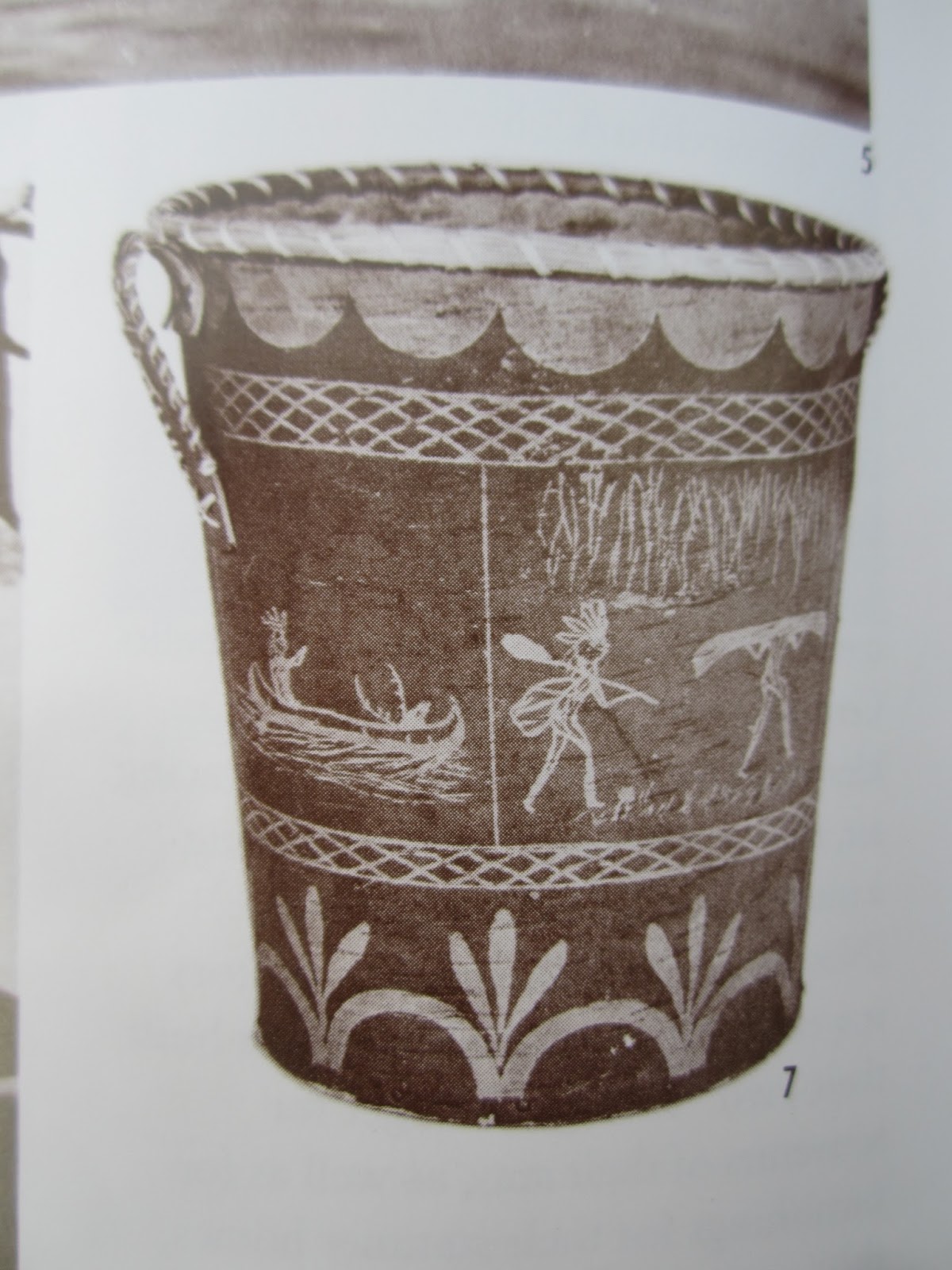
            Enhanced decorative messaging... stepping up from these old New England home classics... are the preferred old money statement of ‘natural’ waste paper baskets; ...old... baskets made of natural New England materials.  For example... ‘made of Birch Bark’.  Preferred are the ‘old’ (1880-1930) ‘souvenir’ type handmade tacked and sewn, sweet grass rim wrapped, all bark bottom and woven sweet grass handled... waste paper baskets.  They are the ‘ones brought back from summer’... at cottage or camp... ‘on the lake’ or ‘in the (White) Mountains’.  “By Uncle Harry’s second wife (“THEY BOTH DRANK”) when they ‘stayed here’ after (the first world) war.  Faint ‘wood burned’ inscriptions stating, for example “Franconia Notch Woodstock N.H.” are a plus... especially if dated, say, ‘1909’.  That the basket has actually been used (lightly) in the home for... ONE HUNDRED YEARS... needs to be understood too.  IF you ‘can find one for sale’ “IT” will be ‘surprisingly expensive.  Either ‘play’ (get your wallet out) or
            ‘Go away’


            Good ones are NOT easy to find.  But they absolutely send the right message.  There are some very expensive birch bark waste paper baskets.  Very expensive.  For very rich people.  But I do not want to touch that right now.*** 


*** :  Being very short:  The most desired birch bark New England / Maine waste paper baskets are those handmade, hand decorated and hand signed by Tomah Joseph, a Passamaquoddy artist associated with Franklin D. Roosevelt and Campobello.  They are the number one. They must be signed and dated. They must be perfect (condition).  Hard ...very hard to ‘see’... even ‘in museums’.  Scarce and expensive in the market.  They are a ‘ten thousand dollar waste paper basket’.  Don’t worry, you will know when your are ‘around one’.  If there is one in use in a home you are visiting... “queue”. 


            What is an example of an acceptable conversion?  Well... commonly, one finds ‘old kegs’ (antique small barrels) used (“converted”).  Popular and findable.  Most prefer the refinished ‘go anywhere’ but the New England antiques collector cult seeks ‘original paint’ and ‘original surface’.  These get expensive.  Not ‘very expensive’.  Just ‘expensive’.  The ‘an old refinished’ surface is the easiest (and most affordable) to find.  Subtle, classic and ‘easy to understand’, these nestle in ‘anywhere’.  I cannot find enough of them.  Usually twenty-five, forty-five, sixty-five... dollars... and rising.  If you find one and like it... buy it.  They ‘don’t grow back’ (turn up).  Don’t get too picky:  It is just a waste paper basket.


            At the start of today’s chapther I stated ‘its imitators’.  There is a new grouping of design... crashers.  Smitten with the discernment of waste paper baskets, the household design furniture object... and the need climb the domestic ladder of ‘old New England’ merged with an aura of ‘old money’... more and more sightings of cheesy ‘new’ waste paper baskets posing as ‘old New England’ waste paper baskets... are, well... “about” and “foisted” from... well... faux old New England Homes.  I know the difference.  It is simple.  Old ones... are real ones... and they are hard to “GET”, “FIND” and “BUY”.  New ones... posing as old ones... do not show the home and its decorator ‘best’.  Got it?  Ok then... again:  If it is phony, it shows that (its phony design) to the people who know and ...those are the ones you least want... “noticing that”.  Just buy the expensive old waste paper baskets, put them appropriately in the home and shut-up.  That is the way it has always been done.   Costly, I understand.  Perhaps checking grandmother’s home for her old waste paper baskets may ease this.


            The bigger point of this essay is that I have tried to convey the suggestion that one actively apply an observant design based awareness to ...everything... and, too, that design observation to ‘all’ as a galaxy of unity... too.  Starting with squirt guns and waste paper basket I have... merely suggested... and now hint at... that denotation of design is not only appropriate for an antiquarian eye but is absolutely needed to be applied to absolutely every object one encounters or chooses to encounter.  I, for example, “LIVE” within design and its observation.  I ‘never leave’.  But:
Yes; there is an on and off switch that you... may... use.  It is okay to take ‘time off’ with your ‘art eye’ and go to a proverbial beach in dirty flip flops and a cheap folding chair.  Just understand that ‘the real ones’ (old New England Wasp decorum) ‘don’t do that’... ever.  Polishing your apple eye for old New England design... is the eternity.  If it is not ‘you’... then ‘don’t.  No one will miss you.


Tuesday, December 1, 2015

The Silver Twin's ...Place... In New England Decorative Art - Part Two - "Aware Sense"


The Silver Twin's ...Place...

In New England Decorative Art

Part Two

"Aware Sense"


            The family name; “Silver”, must be explained.  Originally, during the Colonial Wars, 1750-1760, the male head of household was “an Armstrong”.  Of... English... Colonial... ‘settler’ ‘family’ in the “Dover (New Hampshire) area”.  By the Revolutionary War decade, the Armstrong Colonial settlement family had dispersed ‘along the coast’ (north of Boston) with this settlement dispersial including a ‘handful’ of ‘young’ Armstrongs who were in ‘military service’ in the ‘interior’ of
            Maine territory
            North to the St. Lawrence River and “into” Canada.
            One of them ‘coming back’ (from Canada) came back in the winter on snowshoes with his Native American wife, an “Indian Princess”... it was always told.  She, of “Great Lakes” “Huron” (?), came south, on snowshoes, in the winter, from Canada, “to Maine”.  She, not speaking English and being
            Among those English who could not read and write nor communicate in any Native American “tongue” found the mutually adopted title (name) given her of “SILVER” to be the awkward-but-it-works “NAME” of “HER”.


            This “Silver”; her name, came from her being a Native American woman who, of her dress, wore “silver”.  What this ‘silver’ was ...WAS true silver metal.  The ‘silver’ was small (one inch or one half inch diameter) round open circle (“trade”) “ring brooches”; little (tiny) silver “trade” pins... that were gathered by barter and ‘pinned’ on clothing, usually as decoration AND as display of wealth.  Little rows of silver ring brooch pins.  Having MANY and MANY MORE ‘pinned’; the ‘more rich’ one is.  A ‘few only’ means ‘not rich’?  No.  Few is what most ‘had’.  So... there come... “Silver”.  “She” from her silver trade brooch hoard, pinned on her clothes for display, became the ‘title’ (name) “Silver”.  And of her husband too.  Because... “SILVER”...; everyone understood who this was; who these people called “Silver” were.  That is that; how “Silver” of “Silver Hill” at the top of “Silver Hill Road” and the “Silver Twins Place” (farm).
            Came to be titled.


            This Native American silver name source tale too... helps to explain this Silver homestead settlement... by qualifying.  “Expectations” are explained meaning that for this family to ‘settle’ ‘there’ and ‘homestead’ as a family there, with the ‘very little’ and ‘very small’ (Part One) was not, in fact, “that”.  The homestead settlement was actually perceived to be ‘very big’ and to have ‘a lot’.  It is ‘expectations’ that determined the perceptions of ‘qualify’.  Does this affect the “Silver Twins... place... in New England Decorative art?
            Yes it does, especially if one is perceptive enough to acknowledge that ‘these people’ actually felt themselves to be ‘very well off’.


            What am I going to do now (these days)?  Should I get a metal detector and hunt the Silver Twin’s place site in a wilderness effort to “FIND” a one half inch silver trade brooch dropped and lost on the hillside site in the mid 1770’s?  I know people who ‘do that’.  They would ‘do that’.  They would
            Find that?
            I don’t think so.


            I did know one of those idiots to “FIND” the “SITE” of the (maple syrup) “SAP HOUSE”.  He “FOUND” a “BURIED” clump of mold cast lead sap spiles... just off the lower left corner of the ‘pasture’ (Part One) just past the “break” in the stonewall and ‘into the woods’
            “IT (the ‘sap house’) MUST HAVE BEEN RIGHT THERE”.  For the well over one hundred and fifty years that it was
            “Used”.


            Addressing the sap... spiles... I ...open up a view for you (Part One).  This buried clump of cast lead (pot metal?) is a ‘came up the hill’ (manufactured and imported) design form that came from a ‘went down the hill’ raw natural resource (cut down trees) that was bartered.  These spiles, too, are ‘late’ in the homestead’s settlement (1880-1920’s).  Before... and from the ‘earliest’ settlement period... maple sap gathering to produce ‘maple products’ (syrup and sugar)... the “TREES” were “TAPPED” and upon each tapped tree, a ...carved (whittled) wood... (legend favors ‘maple wood’; the ‘maple touching maple’ legend school of maple syrup purity, but my working discoveries of hand carved wooden sap spile hoards show white pine as the ‘usually used’ wood)... spile was inserted into the tree to ... drain the sap into the sap collection “bucket”.  What kind of wood or even the ‘they are wooden sap spiles’ are NOT my denotations here.  What is my notice is that the hand carved wooden spiles come from the ‘made right here’ group (Part One) of homestead settlement design forms:  A homestead tree was ‘tapped’ and a single hand whittled wooden sap spile was inserted in the tap hole and... the tapping man moved to the next tree and repeated the action.  After ‘sap season’ the spiles were collected (the hole plugged) and they, as a cluster were ‘put away’ until ‘next season’.  These wooden spiles, one for each tapped tree, were carved ‘together’ so sort of ‘look alike’ (show the carver’s hand).  “NEAT HUH”.  


Well... expand the view.  This carved sap spile cluster was... used for years (decades) with only minor supplemental influence... THAT IS VISIBLE TO THE KNOWING ‘design sensitive’ EYE (“aware sense”) right away.  For example, a ‘broken’ or ‘lost’ spile was replaced, usually ‘in the field’ by a whittled replacement... often times made decades after the original spile was carved AND this replacement often was carved by someone of several generations ‘later’; a ‘different hand’.  DO YOU SEE that I am saying that in addition to being a ‘made from there now’ homestead design form that TOO... this design form alters through time and the alterations are visible to the eye when one inspects the cluster of ‘old hand carved wooden sap spiles’ “FOUND” in an old New England homestead?


            At the moment of writing this essay, I have no cluster of old whittled wooden sap spiles that I have found in an old New England homestead... to show off the homestead whittled design form cluster.  I have found many clusters and... sold them all.  I sell them after looking at them... all.  This last ...is... ‘just for me’.  Most ‘do not’ ...any of this.  I advise.


            Helping me today is a similar cluster of homestead wooden ware that, although of a much later era, does ‘do the same thing’ when one is looking at it and looking for design, art, design influence, art design type, singular art design expression and... a wholeness of aura of all that upon such New England homestead clusters.  It is a very simple design form too so this allows one to ‘get it’; understand the broader applications... more easily... I hope.
            I present an “old” coffee can, a ‘pre-zip code’ vintage 1950-60’s Maxwell House “Good to the Last Drop” two pound “coffee can” (no lid) filled with FIFTY ‘wooden clothespins’.  I found this ...classic design form... relic... in an estate contents clean out.  I knew what it was right away so... did not only not throw it out but sensitively preserved it for ME... as what it is...; a real true expression of old New England homestead ‘estate contents’.
            What this is... is what exactly it is:  A ...probably 1950’s New England housewife’s “TIN” of “CLOTHESPINS” that she used to “HANG OUT THE LAUNDRY” outside in the yard.  FIFTY clothespins.  Many “alike” but some odd wooden ones too AND some ‘newer’ wooden ones TOO and... all together in HER CAN that she used so was “the way I have it”; an expression that becomes an art expression within the design forms of coffee cans (coffee cans have a one hundred and fifty year design history) and clothespins (having too the same design history length... if not longer) inclusive of her tweaking her design during the several decades (many decades) she ...and/or... later generations USED THEM.  I may empty the coffee tin, sort and line up the clothespins, commercially evaluate them and... only too...
            SUDDENLY REALIZE THAT THIS WHOLE “THEY” (clothespins in the can) is their true expression; true human expression (having humanity AND humility), when... and only when... the pins and the tin are together... “as she intended” them.  Am I saying this unit is art?
            YES.
            DO YOU GET IT (see it)?
            It is not a big design recognition leap but this leap opens up a very broad view plane (Part One) when one looks at ‘old New England homestead design, it’s history and heritage.
            I am saying that here one finds a woman’s expression of her humanity by her ‘combine’ art design (tin and clothespins) ‘signiture’.  Of HER.  Through her.
            Coffee can filled with her (50) clothes pins.  Can I bring you a more wondrous art gift?
            NO.
            The old coffee can filled with clothespins becomes beautiful... and stunning
            Art.


            I will now take this ‘aware sense’ back to the Silver Twin’s homestead and look around to see more of the homestead’s ... singular... place... in New England Decorative Art.
            But one final notice on the whittled wooden sap spiles.  How many “did he make”?  How many whittled wooden sap spiles did (does) one man make in his life time?  One man whittles one spile for one tree... once ... with that crafting only ‘supplemented’ over ...six or seven... subsequent generations of ‘one man’ who, too, use those same spiles.  So... one man whittles sap spiles that are used by seven men over ...seven generations.  This establishes ‘sacristy’... obviously... but too... reveals ‘actual production’.  The actual production of ‘things’ found in old New England homesteads that are, too, New England Decorative Art... is an important
            “Aware Sense”
            For one to self-develop
            Too.