Showing posts with label bottles glass lamps. Show all posts

Tuesday, May 31, 2016

Before and After: "The Sameness" - "So You're FOR Buttercups"


Before and After:  "The Sameness"

"So you're FOR Buttercups"


Seven years ago I started this antiquarian ‘writing down’ with a five post block presenting the antique New England pickle bottle.  I presented it as it is to me... now, then, back then, before, generations before, these days, those days and in my days... now. Where, when, how, who.  Too.  And... the constituent antique pickle bottle collectors, including their ‘must have – go to’ reference book... too.
            I have ‘gone back’ and read over the posts and so may anyone by pursuing the labels ‘old bottle’, ‘pickle bottle’ and ‘pickles’.  I did not change (edit) anything.  That I did not need... or want... to do.  I found the error that I had ‘occurred to me’ that caused me all this retro reading right away and then, too, found it to be a solid ‘error’ throughout all five posts.  The error is simple enough:  I never serve notice that the reason I choose old New England pickle bottles as the subject is because... it is easy.
            I felt then
            And feel now...
            I feel...
            That they (the antique New England pickle bottle) captures and encompasses all of what I have been writing down ‘ever since’ about New England antiques.  Their collectors, dealers and pickers.  The old New England homes, houses, homesteads, sheds, barns, outbuildings.  Stonewalls, ‘dumps’ and ‘hoard’.  Attics, cellars and summer kitchens.  Back stairs, windowsills, cellar stairs, woodshed windows, dirty barn windows.  Boys and girls playing in barns, sheds.  Wells and their well houses.  Old women and their preference for old pickle bottles in their windows.  Old men who tied bailing twine around a ‘pickle’s’ neck and ‘hung it’ in the center of a barn’s window.
             Dirty wooden boxes...and old cardboard paper boxes full of old dirty pickle bottles in the back of old rusted pickup trucks... hauling them to my yard to “SELL”
            “YOU”
            “THEM”.


            I never said why I picked that topic.  The old New England pickle bottle, when it is applied to my ‘subjects at hand’; the core directives of this blog; it is a very fine and easy choice...
            For it ‘covers all of it’ and
            “Never changes” too.
            In the original five posts I did, ‘pretty much’ cover... the all of it (about ‘pickles’)... without saying that; that ‘pickle bottle’ is an easy choice that covers.  The ‘never changes’ I bring in today.  To ‘bring in today’ I graciously say... in a reversing way... that the old New England pickle bottle
            Is not
            “Trending”.
            It stays where it is and that ‘stay’ comes from where it... was.


            As a candidate for exemplifying old New England decorative taste (“good taste”) of objects, designs, places, settings, inclusions, exclusions and... ‘sending the right message from the corners of the room’, the old New England pickle bottle ‘is that’.  In the posts, I notice the difference between the ‘cathedral’ pickle bottle and the plain pickle bottle as decorative preference and clout.  None the less... “BOTH” are “PICKLE  BOTTLES”.  Choose a ‘one’ or the other... or one ‘may have’ a ‘both’.  TOO.  Dirty in boxes in a picker’s truck.  Washed and “windowsilled” or “Manteled”.  The top of refrigerator is a popular spot too.  And there is too... the  old back stair’s hoard that I ‘grew up with’ in my grandmother’s home.  “That long ago” still stands today... and ‘started’ in the
            Civil War.
            Old New England pickle bottles were used as window decoration in the Civil War.  They were not ‘thrown out’.  They are a solid benchmark of ‘not trending’ ‘old New England’ decorative ‘taste’.
            The old pickle bottle is a shelter of old New England we may all ‘get to’.


            Today, all old pickle bottles and their various etiquettes are unchanged.  They are a little more ‘scarce’, a little more ‘hidden away’ in homes and collections, a little more expensive, a little more “not (for sale) today”.  A little bit more.
            Not a lot more.  No... everything there (“with pickles”) is ‘just fine’.  And no one ‘with pickles’ notices the ‘nots’.  No one brings their old pickle bottle that ‘came from my grandmother’ to ‘display’ at the Historical Society’s annual ‘Discovery night’.  The pickle bottle stays home... and guards the home.  They are still there when a ‘you’ gets back.  They are still there after an “I” (an antiques dealer) leaves the home... after a ‘visit’.  ONLY now and then when the inheritance is declared and the distributions ‘made’ do they falter and, briefly, ‘go in motion’.  I am always around to ‘catch them’ if they ‘fall’.


            The plain pickle may be the best ‘starter’ for the ‘home’.  It is a little less of a dollars and cents commitment... though that price gap has narrowed... so that ‘good ones’ ‘shadow’ the price of the cathedral pickle bottles.  These days.  I remember being ‘undone’ by a sixty dollar price on a ‘plain pickle’.  Now I encounter ‘one (hundred) twenty-five’ “stickered can you believe it?”.  Yes I can believe it.  That is cheap for a true ‘shelter of old New England’.  And it is too... a shelter that may be ‘passed down’ for generations.  One may count on doing that.  I already stated:  Old New England pickle bottles are not trending.  Neither is old New England.  In case you haven’t noticed.  Old New England is just as crouched down behind its stonewalls and Indian (chimney) stairs... as ever.  Old New England continues to ‘escape capture’.  I know because I fight in this war everyday
            Of my whole life.  I notice lots of old pickle bottles in this war.


            A strip mall based mowing – landscape ‘lawn care’ (weed whacking, leaf blowing, [“bark”] mulching and round-up defoliation) services with “HEY GUYS” guys riding the mowers, whacking, blowing, dozing the mulch, and squirting the ‘killer’ pose as the semblance of order standard for the
            New New England .  Semblance of order.  Pose.  Taste.  Declaration of taste.  Demonstration of taste.  Etiquette of taste.
            “If it runs on gasoline they have to have one”.
            “We just don’t do any of that”.
            “So your FOR buttercups?”


            That does not seem to have a lot to do with an old pickle bottle hanging by its neck in a shed window?  This is right.  It does not.  An old pickle bottle hung by its neck in a barn window is an old way of old New England decorative use of an old pickle bottle.  MOST ALL of those old pickle bottles have been taken down from their window and sold.  It is very rare to encounter ‘one hanging’ ‘anymore’.  But the “LAWN” is “PERFECT”.
            In old New England
            So to speak.
            And so is the pickle bottle.  If there is a ‘stoic’ and a ‘suggestion’... the old pickle bottles make them.  Are them.  Welcome to the eye and only ‘spotted’.  If one sees one then one is ‘a message from the corner of the room’ receiving.  If you do not see it... it is not there.  One must look for a ‘better spot’ and ‘try again’.  All this will make sense when one does see one ‘in the (old New England) wild’.  Stop and compare it to the ‘one’s I have at home’.


            If everything I do (with old pickle bottles) is done over and over... then I never have to do it ‘again’.  Over and over I have ‘old pickle bottle’ my life.  Fours years old.  Seven years old.  Thirteen years old.
            Now over six decades have passed.  Pickle bottles have not passed.
            Or changed.
            Not even slightly.  They are an absolute of old New England ‘sameness’.  No:  Not even ‘utterance’ has come from them.  To me.  Simple only... ‘sameness’.  Ever even where they are; on a windowsill... a china cabinet’s top.  A box in a truck.  Tied by its neck and hung in a window.  “LET ME WASH THEM FOR YOU.”
            “No”
            I want them dirty with their old dust dirty bailing twine nooses.  Soldiers in a war hung until dead from
            Spying
            From their barn window on every caller greeted at the front door.  Caller greeted at the shed door.  Even the barn’s door.  “USUALLY WE KEEP THE DOOR OPEN BUT THE NEIGHBORS CAT’S BEEN CATCHING THE
            BATS”.
            Didn’t think there was going to be a tomorrow did they.  I was going to take them down and let them breath again?  No... “NO... NOT TODAY I GUESS.  I WOULD MISS THEM YOU KNOW”.
            “How long do you think they’ve been (hanging) there?”
            “Oh those were there when I was a boy”.


Thursday, December 18, 2014

Old New England Glassware in the Home - Part One - "Cupboards Full... Boxes in the Attic"


Old New England Glassware in the Home

Part One

"Cupboards Full... Boxes in the Attic"


            Mrs. Randolph spoke with me at the antiques show several Sundays ago.  She told me that they (she and her husband) are moving into their cottage in Boothbay and are selling their home.  She wanted me to “advise” her .
            About her “antiques”?
            I... was slow and evasive.  I wouldn’t even call it a ‘response’.
            Mrs. Randolph is called ‘Eve’ by her ‘family’ since girlhood and through her life within her family.  She is called Eve only by her family.  Her family is her inner circle?
            Mrs. Randolph is called ‘Winter’ by her community of friends.  She has always been called Winter by these friends.  I have no idea why.  If, for example, Mrs. Randolph approaches me at the antiques show with two friends in tow... or... was it actually that the two friends had Mrs. Randolph in tow... these friends speak to me of “Winter” “needs your help” “Winter is moving to smaller quarters”.
            “It has the most wonderful view of the harbor”.
            “Winter needs you to look.  She has all kinds of things you know.  Mostly antiques”.
            I doubted that.


            When I arrived I was brought to the dining room first.  Winter was there with her younger sister Caroline.  This was commonly “Carol” and / or “Bing”.  This day it was “Bing” and “Eve” until Sharon arrived and kept calling Mrs. Randolph ‘Winter’.  In the dining room.  We would go off and away from the dining room on a foray to ‘see’ a ‘something’ ‘like that’.  Etc.  We always came directly back to the dining room.
            The dining room had a large and tall (“good height” for modern seating) dining room table with, that day, having its extra leaves ‘in’, so could easily seat eight in the set of twelve (two armchairs) ‘furniture factory’ grade 1960’s faux Chippendale ‘side chairs’.  Twelve ‘including children’ were often ‘seated’ ‘at Thanksgiving’.  This day the table had been ‘set up’ and was ‘covered’ with the ‘glassware’ from the ‘cupboards’.  This display was qualified by Bing with the declaration that “There are more boxes of it in the (top floor) attic too”.  Eve said “Yes, yes; boxes more of it”.
            “Wedding glass” I said.
            Both Eve and Bing looked at me.
            “The world is filled with it; wedding glass.”
            “Some of it is very good quality” said Eve.
            “You use that of course.” I said.
            “Oh no never I don’t want to break it.”
            “Well someone is going to break it....
            Both Eve and Bing looked at me.
            “When you recycle it”.  


            If there was a starting point for a negative ‘turn’ to this ‘estate contents’, it might as well be the suggestion by me that all of the glassware on the dining room table be stacked into plastic crates and ‘recycled’.  “We... put all this out (on the dining table) for you to see”.
            “I see.” I said.
            “There’s more of it in the kitchen we didn’t get out”.
            “I don’t need to see it”.
            “The... glasses are quite old.  Some of them.” said Bing, looking hard a me.
            “And some of them are not very old at all.” I said.
            “All of it is older.”
            “Yes... this here” I said gesturing to the table top display “is 1960’s wedding glassware.  From someone’s wedding.”
            “My wedding.” said Eve.
            “And you’ve never used it.”
            “No.  I never use it.”
            “No one ever does.  It is always ‘kept’.  In the cupboards.  And the attic.
            “Well I never really had any need to use it.”
            “No one ever does.  This” I continued with another hand gesture... “is how that glassware is used.  People like you put it on tables like this and make me look at it.  Did you wash it?”
            “We did.” said Bing.
            “I can tell.” I said.


            The rest of the estate contents looked like this (the dining table top and its glassware) too.  No one had purchased any art or antiques... or rare books... ever.  The ‘things’ in the ‘estate’ had been ‘accumulated’.  As opposed to having been ‘collected’.  Very little object discrimination had been invoked.  There, too, was very little suggestion of ‘taste’...:  An ‘of any taste’ let alone the enigmas of ‘good taste’ and... ‘bad taste’.  Why don’t I is say I noted ‘zero taste’ ‘in there’ and
            Of the old New England glassware.  Too.  It was not old New England glassware on the dining table.  It was junk wedding glass ‘never used’.
            Recycle it.
            Please.


            “If that makes you uncomfortable then donate it to the (strip mall grade box store) thrift store (with their easy drive up donation door).  Their little girls will put all of it out for sale for a month and then clean off the shelf and recycle it (the glassware; all of it).  What did think happens to the glassware in those places?”
            “Oh.” said Eve.  Bing said nothing.
            “It’s quicker just to put it out on recycling day.  If you want to give it a chance put it out a few days early with a sign saying ‘FREE’.”
            “Oh... that’s not what I was expecting.”
            “Well this is what I was expecting and I never wash any glassware like this ever.”
            “How did you know?”
            “Because you have never bought a piece of antique glass ever and you don’t even know what antique glass is (let alone old New England glass).  When ever you’ve talked about glassware... in your life... you’ve used words like ‘juice glasses’ or ‘wine glass’.


“This” I continued, “display looks like the accumulation of someone who knows what a ‘juice glass’ is.  And nothing more.  Don’t get disturbed with me for telling you that.  You invited me to advise you... I believe you said.  I have done that.  It has little to do with me that your glassware is no good.  By no good I mean that it has no commercial value AND that it has no atheistic value.  It is not antique and it is not art.  


“I will be more specific.  Having this sort of glassware, using this glassware pretentiously, storing it in attics and cupboards for eternity, fretting over its breakage is... in my (antiquarian) world... bad taste.  A dead giveaway of bad taste.  This behavior shows that one knows nothing about their glassware, cares nothing about their glassware, in most cases spent no money ever on their glassware and therefore may be summarized as having bad taste in ones glassware inclusive of ones... juice glasses.  I don’t expect you to pay me for telling you this.  But you should.  If you live in a fine old New England in your mind’s eye... then, I tell you to your face, you should at least know of old New England glassware.  Generations before you did and they applaud from their graves what I just said.”


Thursday, October 15, 2009

The Pickle Bottle Lamp


In a northern New England home… may be found one last form of cathedral pickle bottle; the pickle bottle lamp. This is an electric lamp made from an antique pickle bottle. The form first appeared in the 1920's, flourished through early 1960's and, as manufactured conversions, has been on decline ever since. The lamps themselves are not on decline. They command a premium.
In the most simple formula preferably two close matching ("a pair") large and tall and, preferably, cathedral style antique pickle bottles are… "drilled" (meaning a hole is drilled through the glass at center of the bottom) and "electrified" (meaning an electric wire with a plug on the outer end is run up through the hole to a mounted lamp socket at the top of the bottle. The pair of lamps are then divided and placed on side tables, most often at the sides of a sofa and used as "lights". "Everyone" "likes them" is their ever after.
Today the antique market place seeks high quality early conversions (pre-1965). Later conversions, due to collector appreciation of the pickle bottles and … the decline of the availability of high quality professional converters… are not as popular for they are a touch… tawdry. The better quality the old pickle bottle "drilled" (meaning tall perfect form and strong glass color destroyed for collector's by this drilling) mounted with a professionally done handmade quality base and lamp socket mount (that are difficult to "get done" these days for a craft person doing this work well are scarce)… and preferably a pair (thereby doubling all aspects)… the better or best. Late conversions LOOK like late conversions; a sort of cheap 1970-80 hardware casing around an often times NOT drilled pickle bottle (a cork plug socket mount). This last, with the dangling cord at the bottle top means "can tip over" as well as a "visible" cord. The former means "a cheap look".
One needs only brief contact with an early conversion to be ever able to sense those qualities and pass by the later conversions. This early conversion market is competitive and …ever nudging up… pricey. Today the cost of the actual antique pickle bottles merged with the cost of a fine quality conversion then "Mr. Wallet" again with a … quality lamp shade… easily establishes a base cost in one's mind eye that is prohibitive to execute. As the actual look of the lamps is New England home traditional-classic AND ever popular with even the least antiques eyed home decoration viewer AND has a strong salt and peppering of "old money" - "from my grandmother" too… the intersection of object and cost is well defined. The rule is… if one wants… and one sees for sale and… BUY IT. These early conversion are bought, used and stay in use for decades. MAYBE they "are sold" when "they die and they clean out the house". THEN they are promptly purchased and start that exact cycle over right away. The lamps don't appear at flea markets often. They usually are found in better antiques shops in …better communities of … better homes. Expect them to be priced accordingly. A blind luck find is stumbling on a pair inherited by a friend who "hates them" (meaning they "don't know" and have "bad taste"). BUY.
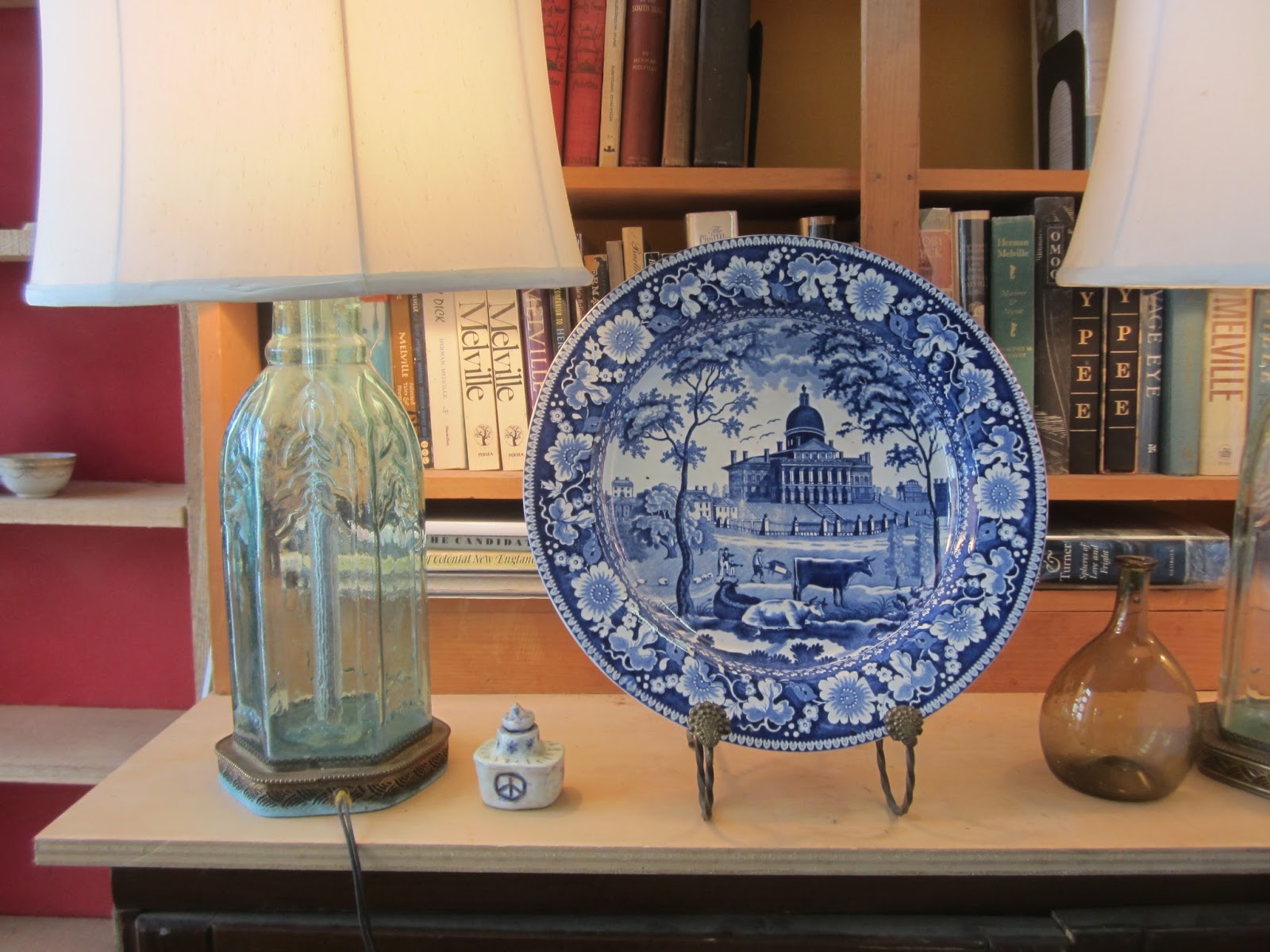
I had to scamper to purloin a pair to photograph. This pair is not an actual cathedral style pair but is the… very usual to encounter… octagon style with a fine late 1950's conversion that includes the hand soldered brass & wood base, the brass mounted socket at the top and, notably, a internal ribbed clear plastic tube hiding the steel shaft inside. This "pair"… although the color match is a little weak and the actual lamp shade height is slight taller on one… indicating that originally the pair was positioned separately in a home… is a very acceptable find these day. They are actually being used to decorate a trestle table… upon old oriental rug… in the center of a book collector's floor to ceiling bookshelf lined collection room. "Everyone loves them".
A classic cathedral pair in matching deep color would be "better" but this set is amplified by the notably fine old conversion. Even the …still works perfectly and are safe… old cords with their frayed covers… sends the "from my grandmother's" message very well.