Showing posts with label Old Bottles. Show all posts

Tuesday, September 20, 2016

A New England Pictorial Flask


When I …purchased "a historical flask" (described in the Old Antiques Store post) using the money from my fruit jar sale and the twenty dollar gift from my grandmother, in the fall of my seventh grade year, I realized the end of a two year trail and held that end in my hand. The trail began in fifth grade when I went, one Saturday morning, to the public library and encountered a newly placed glass display case set up in the lobby housing several antiques on display including a half pint cornucopia and urn American (New England) pictorial flask. I was entranced by the display and the case but was smitten with the flask. There was a vague label ("Historical Flask Bottle") with a local man's name as the lender. That's not what smittened me. It was the …thing. It wasn't, to my eye, a "bottle". It was lying flat on its side; turtle shaped, turtle size and turtle colored but made of glass and had a raised decoration on the visible side of a cornucopia. I stared at it and then viewed it from adjusted angles about the case. I did this for weeks. And weeks. I understood the object was "glass" and "old". I was entranced by it. Defining my entrancement in hide sight, it was the "glass", the color of this glass, the raise decoration that had been clearly and cleverly molded onto this once soft glass and that this same glass was now hard and brittle but one could still "feel" the molten elasticity in the molded decoration. Further, the form DID look like the box and painted turtles I found all the time only this was "OLD" "GLASS". I was smitten,

As a fifth grader, "FINDING OUT" about this "THING" was a long research road that ended up with the unsatisfactory position of… "FINDING OUT" the "what this is"… in a big thick book that …only had a tiny little drawing way in the back of it… among similar "flasks" and crummy black and white pictures of other "old flasks"… but not one like this one and … never getting nearer to the actual "IT" than rubbing my nose on the glass case… which disappeared after six months… and… enhancing this research by not mentioning to anyone my smitten entrancement. I don't even know how I found out about "the book" which was (and still is) the basic classic reference to American Historical and Pictorial Flasks: George P. and Helen McKearin, AMERICAN GLASS, Crown, NY, 1941. (One may easily find a copy of this classic reference.)


There was a brief blank period of… no flask in the library - research over. THEN …at the old antique shop (see post of that title)… an IDENTICAL FLASK appeared for sale for $65.00. AND I could handle it… all over… without ANY restrictions and even freely talk about it and KEEP ON handling it over and over and KEEP ON talking about it EACH and every time I went there. My learning curve LEAPED forward for the handling and the talking yielded a great deal of true facts about the "thing" and …deep, deep, deepest deep "feel" for the object. I was not only smittened and entranced but INFORMED… very quickly. Then, one day, the fruit jar saga took place and …wham - bang… the flask was in my bedroom.


This old bottle, correctly called a cornucopia and urn half pint American pictorial flask in olive green bottle glass, numbered GIII-7 mold pattern by McKearin and made in New England at either a Connecticut or New Hampshire glassworks between 1820 and 1835… still smittens and entrances me to this day.


For others… it does not.


Most of the others are "bottle" or "flask" collectors who consider this flask mold pattern and therefore all of the flasks made in this mold to be… very, very, very, very, VERY common. So common do they commonly consider it's 'so common' to be common that the flask, today as I write is a …nothing. Traveling up the cash value scale in the past forty years to a high of about $150., the flask has fallen back to a "findable at" price of my original $65.00 and even… fifty bucks. Most often one finds them "kicking around" in an antiques shop for "$125.00" and …not going anywhere fast. And that's it.


THAT LAST means that outside of the collector community …that is fully jaded… the little flask has no following. None. Except in old New England homes filled with old New England things that have "always been there" and "show good taste". Either one "knows" what it is or… does not. The latter means, in most cases, not even noticing it. To my eye it is STILL "HOW CAN ANYONE not NOTICE IT?". Even as I write this …with a specimen next to me… I ponder "HOW" can anyone NOT be… smittened and entranced.


The brittle molded glass; light, and so elastically formed yet now HARD. The deep dirty but …crispy clear… green color… caused by heating molten glass with firewood in the New England woods. The mold blown decorative process… used in the New England woods second to it's …only… first usage… by the Romans. The lost-forever- NONCHALANCE- make of the single flask, one of thousands of surviving examples… by a glass blower MAN… who puffed one small controlled breath down his blowpipe to form a bubble of molten glass… and his BOY who closed that bubble in an iron mold. Then the MAN raised the raw molded flask from the mold. The BOY attached an iron "pontil rod" to it's bottom (with molten glass) and the MAN snipped the molded glass free from the blowpipe. The BOY "fire polished" this jagged …top lip of the flask by… sticking the flask (top lip first) back into the furnace "for a second" and then "finished" by… breaking the pontil rod off with a pop. The BOY turned to find the MAN ready with another bubble of glass ready for the mold. They did this all day, every day. The finished flasks were peddled and sold by the dozen as "general purpose containers" to …anyone who would buy any. They were then filled with anything and just about everything and … sold, used and… NOT thrown out due to their very, very obvious positive art qualities that are best summarized as "I LIKE IT". The abundant and therefore "common" qualities of this cornucopia and urn half pint flask are due to the abundant number made and the …"I like it" preservation of the flask… ever after… in old New England homes.


Discover all of this oneself, hunt one of these… glass turtles… down, buy it, handle it and keep it around. The positive art qualities, the old glass qualities, the legacy qualities and the simple "I like it" will last you the rest of your life and return all of your cash outlay in cultural and art discovery. If one is interested in early New England decorative arts, this old glass object is an open door into learning about them. As a single decorative glass object… in the New England home… one sends a knowing message when one displays this …very proper, very subtle and very classic New England pictorial flask.


Monday, August 15, 2016

The Old Antiques Store


The Old Antiques Store


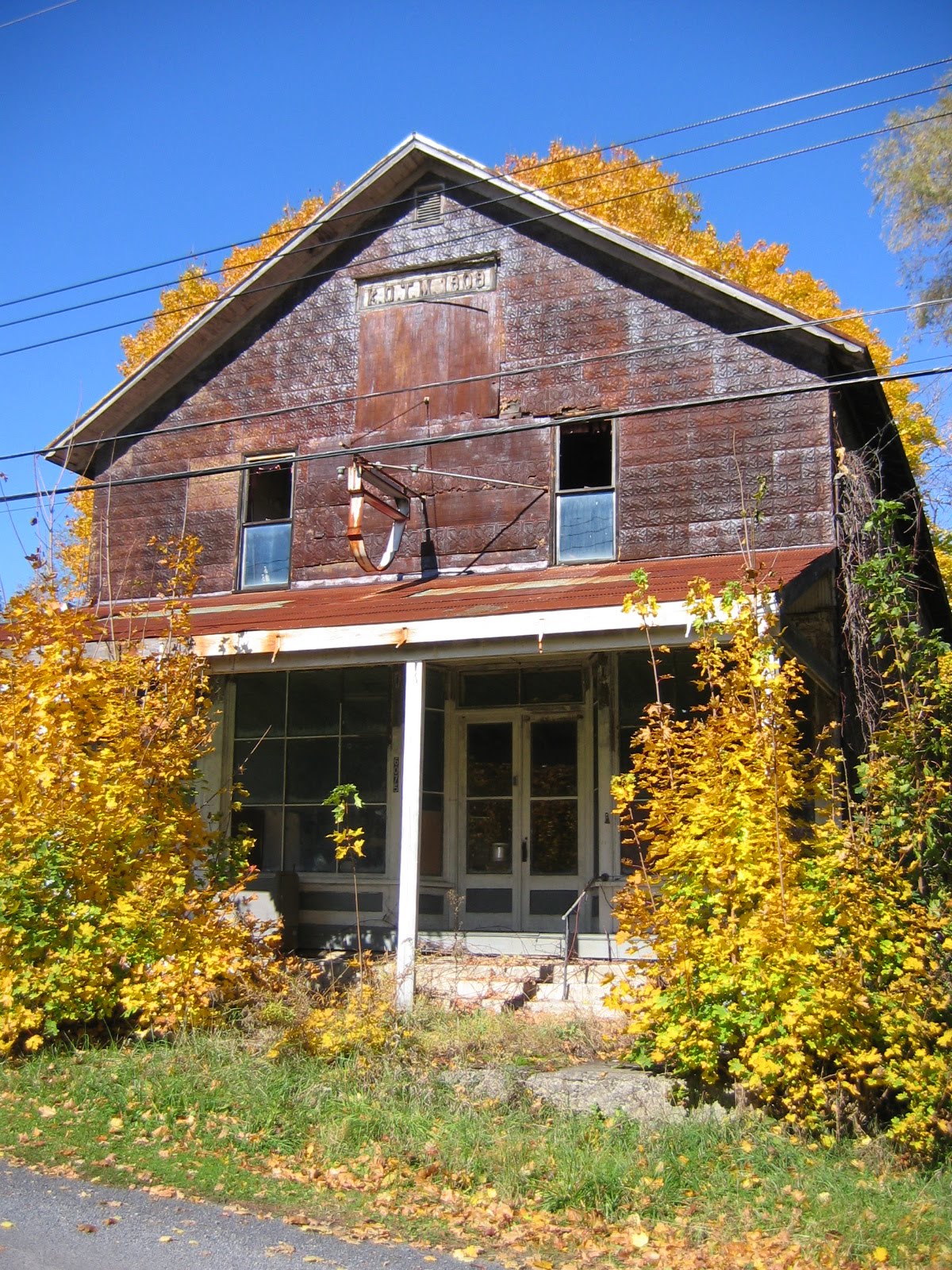
We drove by the old antiques store last month. We drive by it when we are in that area. The old store is not on the main road but is just a tenth mile off of it. This time we stopped and I took a photograph of it. The store has been abandoned and looked like the photograph for at least twenty-five years. It has been thirty-five years this past October since I did business there. It looked less overgrown and abandoned back then but still had the same "old store" appearance.


Today is August 15th, 2016. I last did business at the store in October, 1979. I went to the store for the first time in October of 1966. I was twelve. I went to the store with my soon-to-be Boy Scout assistant scoutmaster. I was a cub scout, soon to be a boy scout.  The assistant scoutmaster had interviewed a group of us prior to our joining his boy scout troop. At that interview, my interest in "antiques" had been voiced under "hobbies". This assistant scoutmaster had a strong interest in antiques too. His interest was more than a hobby. Through a continued conversation about my interest, he offered to take me to the store in the photograph and introduce me to the owner-antiques dealer with whom this scoutmaster did considerable business. We drove there after my dinner, in the dark, on an October school night. We ended up spending hours there. I didn't get home until very late but my mother, who "liked" antiques too, never said anything and seem very pleased that I "had a good time" and "liked antiques". That was my first visit.


Following the directions from my assistant scoutmaster I returned to the antiques store very soon, probably that weekend, WITH my mother. SHE liked the antiques she saw there and we spent hours there. Thereafter we would go to this antiques store every few weeks. 1967 began, I turned thirteen, I joined the boy scout troop and the assistant scoutmaster and I continued our antiques interest exchange. He introduced me to more adult men who "liked antiques". Some of these men knew my mother and that she liked antiques. Along with the men, I met adult women who "liked antiques". Before I knew it I was a member of a little circle of adults who liked antiques, went to this store and were always talking with each other. My interest in antiques expanded avidly and rapidly, helpfully nurtured by these adults. Meanwhile my grandmother had always been an antiques dealer.
Antiques to me at age twelve-turned-thirteen was …finding anything old… anywhere… bringing it home to my bedroom… keeping it… finding out what it was… sort of… and generally having all my other friends think I was weird (unless it was an old rusted rifle or sword). My bedroom filled with this "stuff". I was very protective of my "stuff". My mother never bothered me about my "stuff". I constantly arranged and re-arranged my "stuff" to feature my latest find and… I believe… she was impressed with this management. I never thought I ever found something good and have deeply considered this in hindsight. I believe now that I DID occasionally find something sort of "good" and THAT find… was purloined by my mother to become part of HER "stuff". SHE was constantly… finding anything old and bringing it home TOO, but it took me a few years to realize that "she's serious".


All of this changed one day in the spring of 1967. I had been "turned loose" (my mother's words) by my mother at my uncle's farm with his blessing to "go anywhere you want" and "can have any antiques you find". This was not the first time for this "turned loose" there and… it was a farm with six barn size outbuildings way out in the middle of nowhere and having been built in the 1820's. The setting as just described didn't mean much to me THEN for I considered "these old farms" to be "LIKE THAT" and "normal". The compounding of "this changed one day", unknown even to me, was that MY ability to "find antiques" was "growing leaps and bounds". What started as a nine year old's "curiosity" now blossomed into "THAT'S TOO MUCH WE CANNOT FIT IT IN THE CAR!" gathering processes. As my mother said: "Turned loose".


That day off I went and after several hours of rummaging, retrieving, bringing to show my mother and uncle and leaving in a pile next to the car… I was down on all fours creeping around the bottom of a stairs in an out building and …could just see through the stair crack a "bunch" of "old glass" behind that stairs. I crawled in-under and behind the stairs and retrieved three fruit jars and… skipped them over to the pile after showing them off and receiving just about as much interest in them as I had in them… except that I HAD seen the 1865 dates on the lids of the jars.


The fruit jars rode home, went to my bedroom and …languished. In about a week or so I talked with someone about something and somehow gained inkling that "old fruit jars" were "worth money". I resurrected the three jars, washed the three jars and put them on display… in my room. One jar was called "DEXTER" in print on it's front and this was surrounded by an embossed ring of fruit and vegetables. The other two jars were embossed "FRANKLIN DEXTER FRUIT JAR". After another week I went to the antiques store with my mother. There, in conversation, I told the dealer about my fruit jars. I told him about the one embossed "DEXTER". We left, two weeks went by, we went back and… in conversation… the dealer asked if I wanted to sell the fruit jar embossed "DEXTER". "No." I said  "I will pay forty-five dollars for it" he said. My mother's attention was had. MY attention was had. WE agreed to "SELL THE JAR" and "Bring it next weekend". We did. I had forty-five dollars in cash. I still had the other two fruit jars. The dealer didn't want them.
When we were home, later in the school week, my grandmother was visiting and heard the story from my mother. She hunted me down, congratulated me on the sale and asked "What are you going to do with the money?" I knew what I was going to do with it and told her right away that I "know where there is a historical flask I want that costs $65.00 and as soon as I can get another twenty dollars I am going to buy it." My grandmother… and I have never forgotten this… stood looking down at me for a moment and then… saying nothing… opened up her pocket book and gave me a twenty dollar bill.


I bought the flask. I had, until that day, a job as a paper boy delivering newspapers and a job mowing "peoples" lawns. "Peoples" were like my fourth grade teacher and… such. THAT DAY THAT ENDED and I became an "antiques dealer". That was 1967 and I was in seventh grade. I procured my state resale vendors license two years later in 1969 when I was in ninth grade. I have been an antiques dealer… and rare books dealer… ever since I found those fruit jars and sold the one at… the old antiques store.


Tuesday, May 31, 2016

Before and After: "The Sameness" - "So You're FOR Buttercups"


Before and After:  "The Sameness"

"So you're FOR Buttercups"


Seven years ago I started this antiquarian ‘writing down’ with a five post block presenting the antique New England pickle bottle.  I presented it as it is to me... now, then, back then, before, generations before, these days, those days and in my days... now. Where, when, how, who.  Too.  And... the constituent antique pickle bottle collectors, including their ‘must have – go to’ reference book... too.
            I have ‘gone back’ and read over the posts and so may anyone by pursuing the labels ‘old bottle’, ‘pickle bottle’ and ‘pickles’.  I did not change (edit) anything.  That I did not need... or want... to do.  I found the error that I had ‘occurred to me’ that caused me all this retro reading right away and then, too, found it to be a solid ‘error’ throughout all five posts.  The error is simple enough:  I never serve notice that the reason I choose old New England pickle bottles as the subject is because... it is easy.
            I felt then
            And feel now...
            I feel...
            That they (the antique New England pickle bottle) captures and encompasses all of what I have been writing down ‘ever since’ about New England antiques.  Their collectors, dealers and pickers.  The old New England homes, houses, homesteads, sheds, barns, outbuildings.  Stonewalls, ‘dumps’ and ‘hoard’.  Attics, cellars and summer kitchens.  Back stairs, windowsills, cellar stairs, woodshed windows, dirty barn windows.  Boys and girls playing in barns, sheds.  Wells and their well houses.  Old women and their preference for old pickle bottles in their windows.  Old men who tied bailing twine around a ‘pickle’s’ neck and ‘hung it’ in the center of a barn’s window.
             Dirty wooden boxes...and old cardboard paper boxes full of old dirty pickle bottles in the back of old rusted pickup trucks... hauling them to my yard to “SELL”
            “YOU”
            “THEM”.


            I never said why I picked that topic.  The old New England pickle bottle, when it is applied to my ‘subjects at hand’; the core directives of this blog; it is a very fine and easy choice...
            For it ‘covers all of it’ and
            “Never changes” too.
            In the original five posts I did, ‘pretty much’ cover... the all of it (about ‘pickles’)... without saying that; that ‘pickle bottle’ is an easy choice that covers.  The ‘never changes’ I bring in today.  To ‘bring in today’ I graciously say... in a reversing way... that the old New England pickle bottle
            Is not
            “Trending”.
            It stays where it is and that ‘stay’ comes from where it... was.


            As a candidate for exemplifying old New England decorative taste (“good taste”) of objects, designs, places, settings, inclusions, exclusions and... ‘sending the right message from the corners of the room’, the old New England pickle bottle ‘is that’.  In the posts, I notice the difference between the ‘cathedral’ pickle bottle and the plain pickle bottle as decorative preference and clout.  None the less... “BOTH” are “PICKLE  BOTTLES”.  Choose a ‘one’ or the other... or one ‘may have’ a ‘both’.  TOO.  Dirty in boxes in a picker’s truck.  Washed and “windowsilled” or “Manteled”.  The top of refrigerator is a popular spot too.  And there is too... the  old back stair’s hoard that I ‘grew up with’ in my grandmother’s home.  “That long ago” still stands today... and ‘started’ in the
            Civil War.
            Old New England pickle bottles were used as window decoration in the Civil War.  They were not ‘thrown out’.  They are a solid benchmark of ‘not trending’ ‘old New England’ decorative ‘taste’.
            The old pickle bottle is a shelter of old New England we may all ‘get to’.


            Today, all old pickle bottles and their various etiquettes are unchanged.  They are a little more ‘scarce’, a little more ‘hidden away’ in homes and collections, a little more expensive, a little more “not (for sale) today”.  A little bit more.
            Not a lot more.  No... everything there (“with pickles”) is ‘just fine’.  And no one ‘with pickles’ notices the ‘nots’.  No one brings their old pickle bottle that ‘came from my grandmother’ to ‘display’ at the Historical Society’s annual ‘Discovery night’.  The pickle bottle stays home... and guards the home.  They are still there when a ‘you’ gets back.  They are still there after an “I” (an antiques dealer) leaves the home... after a ‘visit’.  ONLY now and then when the inheritance is declared and the distributions ‘made’ do they falter and, briefly, ‘go in motion’.  I am always around to ‘catch them’ if they ‘fall’.


            The plain pickle may be the best ‘starter’ for the ‘home’.  It is a little less of a dollars and cents commitment... though that price gap has narrowed... so that ‘good ones’ ‘shadow’ the price of the cathedral pickle bottles.  These days.  I remember being ‘undone’ by a sixty dollar price on a ‘plain pickle’.  Now I encounter ‘one (hundred) twenty-five’ “stickered can you believe it?”.  Yes I can believe it.  That is cheap for a true ‘shelter of old New England’.  And it is too... a shelter that may be ‘passed down’ for generations.  One may count on doing that.  I already stated:  Old New England pickle bottles are not trending.  Neither is old New England.  In case you haven’t noticed.  Old New England is just as crouched down behind its stonewalls and Indian (chimney) stairs... as ever.  Old New England continues to ‘escape capture’.  I know because I fight in this war everyday
            Of my whole life.  I notice lots of old pickle bottles in this war.


            A strip mall based mowing – landscape ‘lawn care’ (weed whacking, leaf blowing, [“bark”] mulching and round-up defoliation) services with “HEY GUYS” guys riding the mowers, whacking, blowing, dozing the mulch, and squirting the ‘killer’ pose as the semblance of order standard for the
            New New England .  Semblance of order.  Pose.  Taste.  Declaration of taste.  Demonstration of taste.  Etiquette of taste.
            “If it runs on gasoline they have to have one”.
            “We just don’t do any of that”.
            “So your FOR buttercups?”


            That does not seem to have a lot to do with an old pickle bottle hanging by its neck in a shed window?  This is right.  It does not.  An old pickle bottle hung by its neck in a barn window is an old way of old New England decorative use of an old pickle bottle.  MOST ALL of those old pickle bottles have been taken down from their window and sold.  It is very rare to encounter ‘one hanging’ ‘anymore’.  But the “LAWN” is “PERFECT”.
            In old New England
            So to speak.
            And so is the pickle bottle.  If there is a ‘stoic’ and a ‘suggestion’... the old pickle bottles make them.  Are them.  Welcome to the eye and only ‘spotted’.  If one sees one then one is ‘a message from the corner of the room’ receiving.  If you do not see it... it is not there.  One must look for a ‘better spot’ and ‘try again’.  All this will make sense when one does see one ‘in the (old New England) wild’.  Stop and compare it to the ‘one’s I have at home’.


            If everything I do (with old pickle bottles) is done over and over... then I never have to do it ‘again’.  Over and over I have ‘old pickle bottle’ my life.  Fours years old.  Seven years old.  Thirteen years old.
            Now over six decades have passed.  Pickle bottles have not passed.
            Or changed.
            Not even slightly.  They are an absolute of old New England ‘sameness’.  No:  Not even ‘utterance’ has come from them.  To me.  Simple only... ‘sameness’.  Ever even where they are; on a windowsill... a china cabinet’s top.  A box in a truck.  Tied by its neck and hung in a window.  “LET ME WASH THEM FOR YOU.”
            “No”
            I want them dirty with their old dust dirty bailing twine nooses.  Soldiers in a war hung until dead from
            Spying
            From their barn window on every caller greeted at the front door.  Caller greeted at the shed door.  Even the barn’s door.  “USUALLY WE KEEP THE DOOR OPEN BUT THE NEIGHBORS CAT’S BEEN CATCHING THE
            BATS”.
            Didn’t think there was going to be a tomorrow did they.  I was going to take them down and let them breath again?  No... “NO... NOT TODAY I GUESS.  I WOULD MISS THEM YOU KNOW”.
            “How long do you think they’ve been (hanging) there?”
            “Oh those were there when I was a boy”.


Thursday, October 15, 2009

The Pickle Bottle Lamp


In a northern New England home… may be found one last form of cathedral pickle bottle; the pickle bottle lamp. This is an electric lamp made from an antique pickle bottle. The form first appeared in the 1920's, flourished through early 1960's and, as manufactured conversions, has been on decline ever since. The lamps themselves are not on decline. They command a premium.
In the most simple formula preferably two close matching ("a pair") large and tall and, preferably, cathedral style antique pickle bottles are… "drilled" (meaning a hole is drilled through the glass at center of the bottom) and "electrified" (meaning an electric wire with a plug on the outer end is run up through the hole to a mounted lamp socket at the top of the bottle. The pair of lamps are then divided and placed on side tables, most often at the sides of a sofa and used as "lights". "Everyone" "likes them" is their ever after.
Today the antique market place seeks high quality early conversions (pre-1965). Later conversions, due to collector appreciation of the pickle bottles and … the decline of the availability of high quality professional converters… are not as popular for they are a touch… tawdry. The better quality the old pickle bottle "drilled" (meaning tall perfect form and strong glass color destroyed for collector's by this drilling) mounted with a professionally done handmade quality base and lamp socket mount (that are difficult to "get done" these days for a craft person doing this work well are scarce)… and preferably a pair (thereby doubling all aspects)… the better or best. Late conversions LOOK like late conversions; a sort of cheap 1970-80 hardware casing around an often times NOT drilled pickle bottle (a cork plug socket mount). This last, with the dangling cord at the bottle top means "can tip over" as well as a "visible" cord. The former means "a cheap look".
One needs only brief contact with an early conversion to be ever able to sense those qualities and pass by the later conversions. This early conversion market is competitive and …ever nudging up… pricey. Today the cost of the actual antique pickle bottles merged with the cost of a fine quality conversion then "Mr. Wallet" again with a … quality lamp shade… easily establishes a base cost in one's mind eye that is prohibitive to execute. As the actual look of the lamps is New England home traditional-classic AND ever popular with even the least antiques eyed home decoration viewer AND has a strong salt and peppering of "old money" - "from my grandmother" too… the intersection of object and cost is well defined. The rule is… if one wants… and one sees for sale and… BUY IT. These early conversion are bought, used and stay in use for decades. MAYBE they "are sold" when "they die and they clean out the house". THEN they are promptly purchased and start that exact cycle over right away. The lamps don't appear at flea markets often. They usually are found in better antiques shops in …better communities of … better homes. Expect them to be priced accordingly. A blind luck find is stumbling on a pair inherited by a friend who "hates them" (meaning they "don't know" and have "bad taste"). BUY.
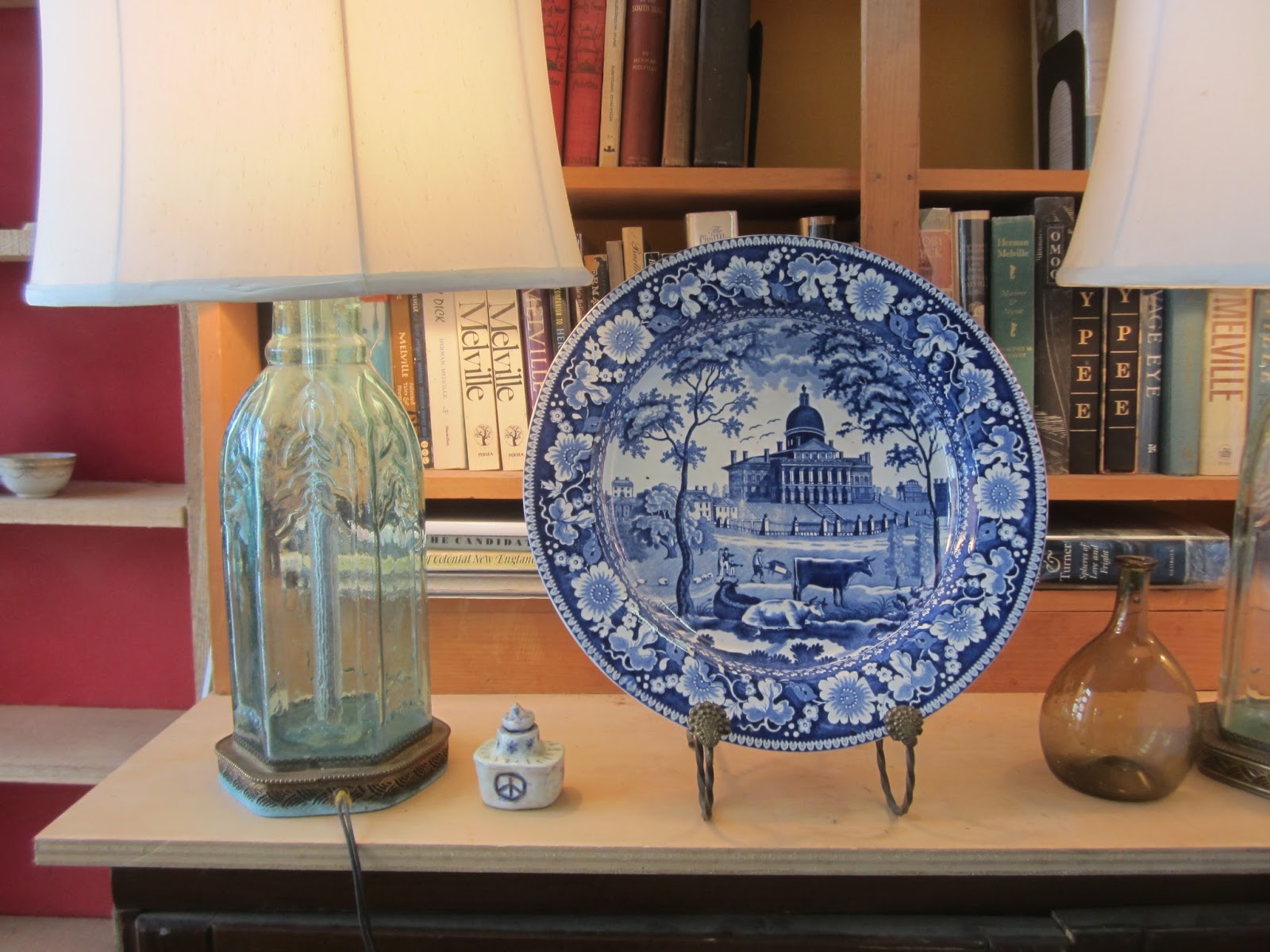
I had to scamper to purloin a pair to photograph. This pair is not an actual cathedral style pair but is the… very usual to encounter… octagon style with a fine late 1950's conversion that includes the hand soldered brass & wood base, the brass mounted socket at the top and, notably, a internal ribbed clear plastic tube hiding the steel shaft inside. This "pair"… although the color match is a little weak and the actual lamp shade height is slight taller on one… indicating that originally the pair was positioned separately in a home… is a very acceptable find these day. They are actually being used to decorate a trestle table… upon old oriental rug… in the center of a book collector's floor to ceiling bookshelf lined collection room. "Everyone loves them".
A classic cathedral pair in matching deep color would be "better" but this set is amplified by the notably fine old conversion. Even the …still works perfectly and are safe… old cords with their frayed covers… sends the "from my grandmother's" message very well.


Wednesday, October 14, 2009

Zumwalt (On Pickles)


Between… Baxter's antiques picker find in Missy Adams' shed of the shelf of plain pickles together with the barn soiled cathedral pickle …and… Mrs. Abbott's very appropriate Maine coastal home decorative assemblage of three cathedral pickle bottles… one finds a third active critter; the old bottle collector... refined to the …old pickle bottle collector.
Generally young middle age males NOT decorative in impulse (excepting the intervention of "the wife") but outstandingly appreciative and sensitive to the "old glass" qualities of an old pickle bottle… the weight of their "Mr. Wallet" as collectors rests steady upon any cathedral pickle bottle. They "collect". They "keep". They "find". They "SELL". Constantly. Mrs. Abbott's three are their regular quarry. "Common" but "good", "saleable" and… "my wife likes them", these collectors defer to a select group within their number who actually …very seriously… "collect". Behind THESE collectors is a single book that guides them; "ZUMWALT", so stated.
Betty Zumwalt's KETCHUP PICKLES SAUCES 19TH CENTURY FOOD IN GLASS, Mark West Publishers, Fulton, CA, 1980 is THE reference book for old pickle bottles. Collector focused and comprehensive in scale, the tome obsesses to record every old pickle bottle there is, carefully describe it and, for most, crudely picture a specimen. The core of the book is an alphabetical compendium of letter embossed old (pickle) bottles. The NOT letter embossed bottles (such as Baxter's and Mrs. Abbott's) are given short space at end of the book. This does not diminish interest in these bottles or their value. For example, a non letter embossed AMBER colored cathedral like Baxter's, perfect, with a rough glass pontil… would be priced at six to ten thousand… or more and see very, very, very strong collector interest. (Mrs. Abbott's interest would be nowhere in sight.) Should that bottle be letter embossed… even more cash value. And even more, more; if that bottle be as described but NOT recorded by Zumwalt ("not in Zumwalt") and… (a must) be (uniformly acknowledged by all collectors without ANY qualifying) "AMERICAN"… even more, more cash value. But the word for this post is ZUMWALT.
Baxter knows "ZUMWALT" and did not need to refer to a copy for he knew that without letter embossing… his find had a DEAD SERIOUS cap on it's cash value. I did not need Zumwalt for the same reason. Mrs. Abbott doesn't even know Zumwalt exists and wouldn't care except to say something like "OH ISN'T THAT A NICE BOOK" if one ever bothered to show it to her. But: HER Mrs. Wallet is the one that …rests steady on the classic cathedral pickle bottles we have amplified in these posts. She IS the market top.
This book; "ZUMWALT". is valuable to these posts as a "should know about"; should know that the word "ZUMWALT" carries "must have" clout among old pickle bottle collectors and… know that the actual book is out of print, only found in the secondary market, sells for between $30.00 and $50.00, is high quality attractive hard cover in dust jacket and… should consider that the book may actually have an odd "Wow NEAT!" - one cannot go wrong - conversation starting - coffee table - back of the toilet decorative display value …in a northern New England home.


Tuesday, October 13, 2009

Old Pickles In The Window


I took Baxter's box of the plain pickle bottles and set the bottles on the board to take their picture. Mrs. Abbott watched and then said "WHAT ARE YOU DOING?"
"Taking their picture" I said.
"WHY?"
"I like them."
"WHY? They're DIRTY. WHAT DO YOU DO WITH THEM! I DON'T LIKE THEM." She walked away and spent the next hour touring our gardens with my wife. That's what she means when she said she "wants to look around".
Her "I don't like them" and my "I like them" provides a concise example of an irreconcilable gap in Northern New England decorative taste. "I like them" because the first pickle bottles I ever saw looked just like these, including being dirty. They were lined up in a window "up the back stairs" in the back L of my grandmother's house. I walked by them on the way to my bedroom. Other homes had these plain pickles in windows too; in the home, the sheds and the barns. It was at least a decade after noticing my grandmother's (at about age three) before I ever saw a cathedral pickle bottle. The reason for that was that they were "valuable" and if one found one, one sold it. This action included my grandmother. My learning curve was the same; I take the row of plain dirty pickle bottles in the window as a standard Northern New England domestic decoration and absolutely sell a cathedral if I find it.
The plain pickles lined up in the window are a classic and affordable northern New England decorative statement. So are the cathedral pickles. The difference, that is irreconcilable, is economic. Mrs. Abbott may afford a row of perfect cathedral pickles decorating her home. Her northern New England taste is splendid but… she is "from away" (moved to Maine and brought her money with her). She never saw a row of plain dirty pickles in a shed window from where she "comes from". Indigenous Mainers decorated with the row of plain pickle bottles in the window. This too is splendid taste. Should they possess a cathedral and they glimpse it, they see dollars. Selling that cathedral is too much to resist for their decorative impulse can make do with just plain pickles… in the window.
The smaller plain pickles may be found at flea markets for $2.00 to $12.00 and more. The big fat one on the left will cost a lot more these days; $75.00 to $125.00 with a chance find for much less ($25.00). The tallest bombay swell pickle to the right is very popular and an easily spotted form but are usually $75.00 to $125.00 also. They are possible to find for a bargain but one must be vigilant and act promptly.


Monday, October 12, 2009

Peggy's Cathedral Pickle Bottles


At mid morning (8:30 AM Maine time) I called Peggy (Mrs. Margaret Bacon Abbott) who I call "Mrs. Abbott" even though she's a decade younger. "Peg" or "Peggy" collects antiques following the heritage of her mother and grandmother. She and family moved to Maine from South Chatham on Cape Cod. Her mother came to me first. She told Peggy I was "ok". That critical appraisal, common to my experience, means I know about and sell the right kind of antiques. The right kind of antiques are the antiques that Peggy's mother's mother told the mother "are good". "Are good" means traditional, classic and understated decorative arts made in New England prior to 1840. One's old Maine home is decorated with these objects and …NOT TOO MANY of them. It should NOT look like one collects. It should look like one inherited all of them. The actual collecting is the ever continuing musical chairs style upgrading where a single item is replaced by a better specimen and the former… sold. Some objects (almost) NEVER are sold, replaced or even moved because they actually were inherited.
I told Mrs. Abbott about the pickle bottle critically noting that it was "tall" and "fancy" and would compliment the pair I had sold her nearly a decade before. "It will sit well between them" I said. "I will bring it down for you to inspect".
"I'M GOING INTO TOWN RIGHT NOW AND I'LL COME BY I WANT TO LOOK AROUND ANYWAY" she shouted into the telephone and hung up.


Two hours later she arrived with her two pickle bottles. We put our new bottle out, her bottles out, put them all side by side and took pictures of all of them. Mrs. Abbott's pair of cathedral pickle bottles are a large and deep colored pair of classic cathedral pickles. They are a "THE CLASSIC PAIR". We found them in an estate in Phippsburg, Maine. They were being used as decoration in the living room. I sold them to Mrs. Abbott who lives six miles away. She uses them as decoration in her living room. "THEY ARE NICE TOGETHER" she said. "I WANT IT". We hadn't discussed price.


As I packed her pickle bottles with Baxter's pickle bottle she went to her car, opened the hatch back and pulled out an old chair. "I DON'T WANT THIS ANYMORE DO YOU WANT IT" she shouted. I looked at the chair. I knew the chair. It is a Connecticut style four slat sausage turned ladder back side chair, circa 1760, with fine tall finials, a rewoven rush seat and a mid 1950's black painted and Hitchcock style gold stencil decorated surface. She had it a back hallway alcove next to the new kitchen. It was her mother's. The mother probably got it from her mother. The family was originally from Connecticut. Mrs. Abbott's mother probably paid to have the seat replaced and the painting done by a professional on the Cape. "YOU HAVE TO TAKE THIS BECAUSE I DON'T WANT IT BECAUSE I TRIP OVER IT AND SO DOES EVERYONE ELSE".
"How much?" I queried having been along this trail before.
"ONE HUNDRED NO… EIGHTY…NO… SEVENTY" She shouted from the car's back and started moving the chair toward me.
"I can pay a little more" I said.
"NO".


Saturday, October 10, 2009

Baxter's Cathedral Pickle


Baxter's Cathedral Pickle

I would have made the first post yesterday but I had to dig up the septic tank for a maintenance pumping first thing. It was still dark when I'd cleared the cap and freed it. A truck went over the hill and I recognized the lights and sound as Baxter's. He's an older local picker and always comes first thing in the morning when he's found something. He finds the something the day before, makes his wife research it on the internet (to the best of their combined abilities) in the evening and sells at dawn. His truck pulled up next to me.
"WHAT …are you DOING?"
"Digging up the septic."
"WHY?"
"Maintenance pumping."
"Now?"
"Now."
He looked at the tank cap, looked at me, look straight out the windshield and turned the truck off. "I GOT SOMETHING YOU WANT!" he said and got out of the truck. That's his usual sales pitch but was a little louder suggesting a concern that my attention might not be centered on him.
He took a wooden box full of bottles out of the truck bed and set it up inside my barn door. He went back to the passenger cab and retrieved another bottle. Waving it at me in the dawn light he said "THIS IS IT". He sat that on the very front of the barn doorway.
I saw right away the bottle was a large cathedral pickle bottle; a tall one. I walked up, picked it up, held the dirty bottle to the dawn light, turned it over and said "How much?"
"Two fifty. Its perfect"
I said nothing, rolled it again and sat it back down, but back from the edge, just inside the barn.
"GOT ALL OF THEM from MISSY ADAMS' PLACE."
We stepped to the wooden box and looked down. They were all old, but plain, pickle bottles. "How much are those?"
"ONE HUNDRED."
I said nothing.
"That one has GOT to be worth two hundred" he said.
"Is that the price?"
Baxter gave me a look I'd seen before. He gets so excited about his find and researching the object's value that he falls apart at selling. That look means that he cannot remember what price he'd quoted me the minute before. He'd been rehearsing the price all the way over in the truck but couldn't recall what he'd actually quoted. "Well… I guess so" he said.
"I'll buy it" I said.