Showing posts with label Reference Books. Show all posts

Wednesday, February 22, 2017

Why is "The Old Dark Blue" the "Old Dark Blue" in Old New England - Part Six - "Your Landscape"


Why is "The Old Dark Blue"

the "Old Dark Blue"

in Old New England

Part Six

"Your Landscape"


            Twenty-five years ago I made a routine stop at a Greenwich, CT. thrift shop.  It was a first-thing-in-the-morning ‘on my way to’ (Old Greenwich) so I made a get-in / get-out typical “STOP”.  A few were in the store but not of an antiquarian seek.  Women’s fashions and their accessories “ahhhh”... so I was all alone.
            Behind the counter and over the counter manager’s left shoulder I spotted an antique The Old Dark Blue teapot right away.
            “How much is the old teapot?”
            After ‘reaching it down’:  “Sixty-five dollars”
            “I would like to buy that please”
            “Fine”.
            "I want to look around a little more”.
            “Fine”.
            “Thank you”.


            What I bought then I do not have now for I “sold it right along”.  But... today... I do “have one”; an ‘identical’ teapot ‘in stock’.  I am partial to the (decoration pattern) ‘series’.  I always notice that particular ‘scene’ and “watch for it right along”.  No real surprise to find “it” “donated” in the upscale of the Greenwich area:  Someone once ‘knew’.  I still
            Do.
            What I know is that the fragile blossom of The Old Dark Blue has always held high this particular pattern for me.  I showed that off way back with my first estate sugar bowl carrying the “Gilead House” transfer scene (Part Two).  That sugar’s scene is from the same series as the scene on the teapot.  The teapot’s scene is titled on the pot’s bottom “Denton Park Yorkshire”.  The formula of the transfer; the makeup of the transfer’s design, “matches” that of the Gilead sugar bowl.  They are from the same tea service ‘set’ (‘tea ware’).  For the record, and evidently, ‘no one knows where (or what) “Gilead House” was (is)’.  That does not diminish the positive decorative quality of the transfer scene or the ‘series’.  For this series’ patterns... most all viewers succumb to “I LIKE IT”.  It is an easy ‘to go with it’; this simple ‘it’s nice’.


            Anyway:
            What I also knew then and still know now is that my favored taste for this teapot is not an epistle from me.  No... no one cares what I ‘like’.  Or think.  A few may tolerate an ‘I feel” but they usually prefer to ‘feel’ that way ‘too’ “to start with”.  This good feelings toward this teapot is because the in-the-know KNOW THAT this pattern series teapot “IS ON THE COVER OF THE BOOK”
            “What book?”
            It does not matter for you to know that.  Either you know that or you
            Do not know that.  If you do not know that it does not matter for you are...
Anyway.  If you do know and have the book too then what you feel is ‘right’ and you don’t care what the ‘rest of them’ feel ...about anything anyway.  Having someone come up to me and self start to express what I just wrote ...does not happen very often... even in The Old Dark Blue circles of ‘feel’ that I travel in.  That does not change anything:  The ‘teapot’ (decorated of this series) IS on the ‘cover of the book’.  A core suggestion is that IF you have a... whatever... that is on the cover of a book about that decorative art object’s merit and heritage... (“good taste”)... one is ‘on solid ground’ “with that”.  If one wants to be on super solid grounded... one should purchase a copy of the book and have that “around” “TOO”:  Solid grounding is my intention here; in your hand WITH the... Old Dark Blue... teapot.


            If you glance at the cover of the book to affirm, then bring your eye back to actual teapot.  There should be an internal radiance with ‘it’ and ‘you’ “now”.  And that radiance... I have built in this essay to become a ‘your landscape’ with The Old Dark Blue... right here... right now.
            I have developed a heritage based appreciation of The Old Dark Blue by establishing its age, history of design, function, place of function, usage, usage heritage, presence (in the Old New England home), preservation of object, heritage based notice of the object (including ‘great grandmother’ style old notes on paper wisps inside The Old Dark Blue [Part Five]).  I have suggested that to participate in this (The Old Dark Blue is The Old Dark Blue in the Old New England home) one may do that with the very nominal (monetary cost) acquisition of a specimen (an ‘old broken sugar’ bowl for example) (or here; at teapot from behind the counter of a New England thrift shop that... YOU... “FIND”).  I am suggesting that all one needs to establish that one is of the “I know” of The Old Dark Blue... in the Old New England home... is to very unobtrusively... ‘display one’ in your (old New England) home.  It... sends a “the right message”.  It should be
            Your Landscape.


            And I am done with you?  No.  The war needs you in the army.
            “WAR?” you say.
            Yes... just go to a box store at look in the shopping carts at what ‘they’ are ‘buying’.  If you have an Old Dark Blue broken sugar bowl at your home... you will not ever find a “THAT” “HERE”.  No.  Welcome that.  And live your life that way.
            “What way?”
            The way your own great, great, great, grandmother wanted you to... and has tried to convey to you... THROUGH her ‘old china’.  One rescues oneself when one... rescues your greatest great grandmother’ “old china”.  And establishes the landscape of that ‘good taste’ for self.  After being ‘around it’ for a few years... including the ‘looking at it’ and ‘handling it’... one becomes very adapted to the ‘noticing it’.
            And, of course, the NOT noticing it (because it is, in most settings, ‘not there’).  No... you will become like I where one has ‘they don’t know’ foisting their “THAT” upon you... where ever you ‘go’.  But when one does have a radiant encounter... a ‘does know’ messaging of Old New England good taste... oh does not THAT
            Delight.


            Isn’t funny what an old broken china sugar bowl may turn out to be?  “Yes” and “It’s English too”.
            Yes... English too.  A Wasp barrier reef right there.  Keep that in mind... when a message from ‘her old china’ in her ‘old china cabinet’ fires as a cannon at you.  Looking more carefully at that message source one sees, again, an “English Landscape”... with a castle spire centered up above a nocturnal (moonlight) sail boat.  Clouds, moon, water surface and sailing boat... surround... an old English castle?
            No.
            This is, great grandmother assures you, a ‘well known’ American scene:  Wadsworth Tower, here a single series view of a mountain top (Avon, CT area) 1810 view tower built by Daniel Wadsworth.  It blew down in 1840 but... in 1826... researchers have discerned a local (Hartford area) newspaper advertisment for a ‘new and most beautiful pattern of tea ware call Wadsworth’s Tower”.  That is what this is; this (broken and lid lost) old sugar bowl.
            “My”
            And great grandmother’s mother’s ghost holds your hand for just that second.
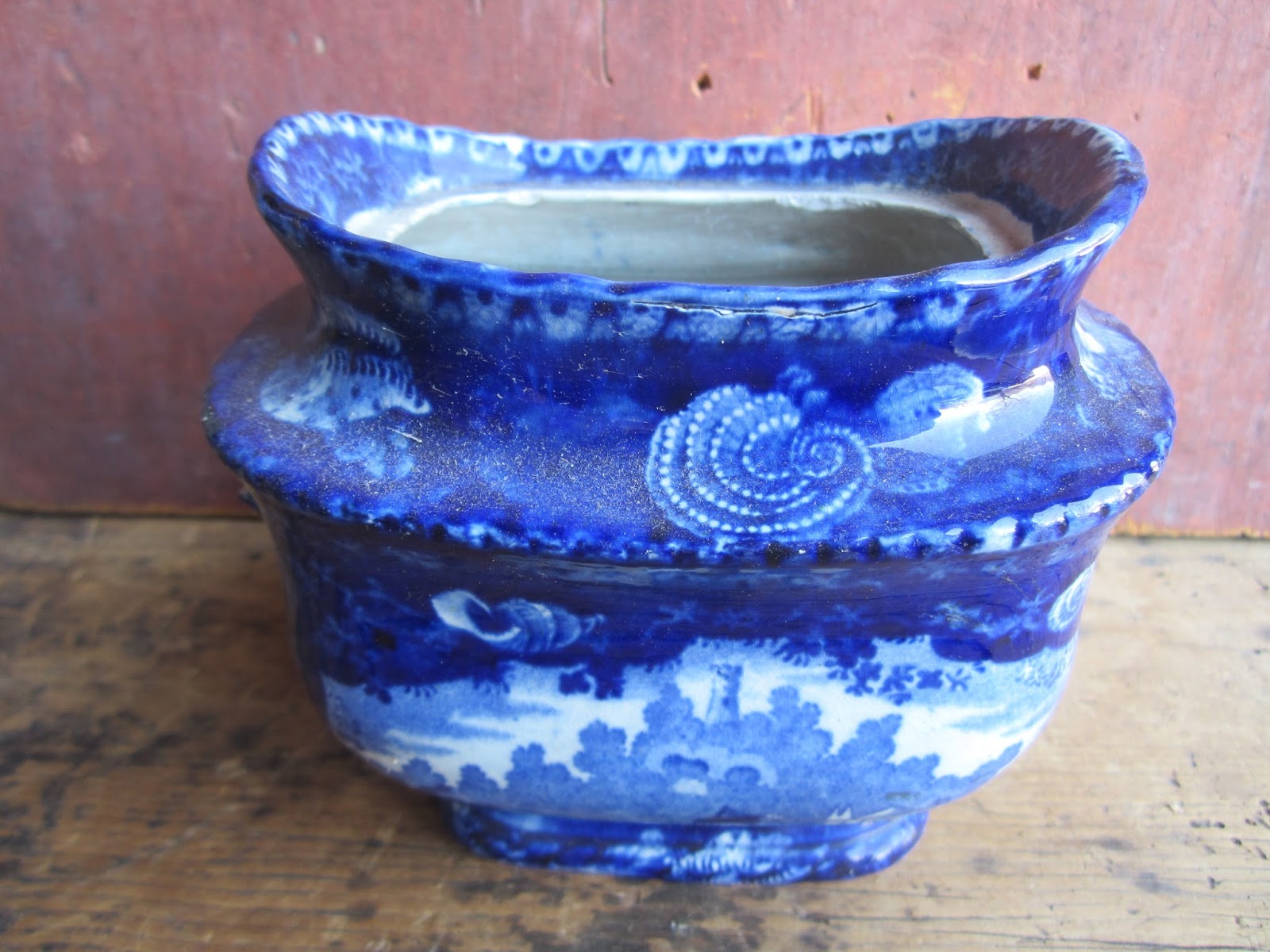


            Do not let this get away.  Pursue this... ‘old china’ clarity.  Admittance is nominal.  Your landscape may be English or American ‘scenes’.  Or perhaps ‘floral’.  Or... even... “ships” battling at sea, off, for example a “The Gold Coast”... whatever that is.  This doesn’t matter.  What matters is that the heritage of “The Old Dark Blue” in the Old New England home... is understood.  You do not even need ...to feel... “I like”. That is why we have box stores in Old New England:  To “take you off”.  “Rid of you”.  As I said, your landscape is your barrier reef.  In plain sight... on YOUR shelf.  That’s what it does.
            For you
            It is your landscape.
            That is why “The Old Dark Blue” is The Old Dark Blue in the “Old New England” and its homes.
            As a final note I add that this old china has been protected in this way for very long time; from ‘day one’.  By 1875, ‘collectors’ of The Old Dark Blue were well establish including petty pattern squabbles amongst themselves and published printed catalogs of “old curiosities” dealers vending, exclusively ‘The Old Dark Blue’ “ware”.  This carries back to the “I KNOW” realization that “This” (The Old Dark Blue) was collected ‘in the (old New England home) from, too, the above noted ‘day one’.  Yes:  The great, great, great grandmother’s ‘good taste’ has been there since ‘day one’ of the ‘my old china’.  The Old Dark Blue never looks for a ‘space’ in the ‘parking lot’.


Thursday, October 6, 2016

Fall Harvest; The Vanishing Corn Bundle


Each fall, in the middle of the fall season, I catch a glimpse of a classic northern New England decorative antique, the corn bundle in the corn field. The corn bundle is the vertical stack of dry corn stalks …with the drying corn ears still attached… that have been cut, gathered in approximately ten stalk clumps, raised upon each other to form the bundle and tied two-thirds of the way up with corn stalks that synch the bundle in and give it classic form. A field of cut corn is bundled and becomes, as the photographs show, a classic icon of the New England fall harvest.
So classic be these bundles in the corn field that… to even the romantic New England eye… they are hardly noticed. One's car goes by them at sixty-five. This chance notice is difficult too for, these days, a field of bundled corn is quite scarce to encounter, even at sixty-five. Furthering this viewing scarcity is that the bundle progression is done only as a brief step in the process of the corn harvest. 


The corn is cut the first day, stacked and bundled the next and then… these whole bundles are intended to be moved to the barn the third day ("before they get wet"). Weather permitting. This is the quick plan and process is often delayed by weather BUT STILL is done quickly. The bundle stage, the most picturesque, is designed to shed any water AND keep the inner corn fresh dried; a light green. We were lucky to find and photograph a bundle torn open by the wind that shows the dried green corn stalks inside. The whole point of this harvest style is to process the corn to be a winter feed; a sort of original form of silage, for cows. For the romantic New England eye, the moment of bundles of corn in the field is very short.


There is very scant reference to corn bundles in the field. One may find abundant pictorial usage, nearly formulaic, but discussion is very scant. Even Eric Sloane, who includes a superior color print of his painted view of the corn bundle harvest as the frontis for his "Autumn" chapter in his THE SEASONS OF AMERICA PAST (Funk, New York, 1958, after page 82) (see our photographs) gives no written commentary on the bundle or bundle process.
Once one understands that one is looking at a… classic… fleeting moment of a …classic… New England harvest, slowing down and gazing fondly becomes one's norm. Then one may chance to see the bundles being made and tied, usually by several men accompanied by small children and dogs (just as Sloan portrayed). Savor this view. The whole process will be gone in a few days; the field will be bare stubble ready for the winter snows… flocks of geese… and crows. As the corn bundle harvest practice continues to wane, I personally view each field as if it's my last contact with this classic northern New England antique.

Tuesday, September 20, 2016

A New England Pictorial Flask


When I …purchased "a historical flask" (described in the Old Antiques Store post) using the money from my fruit jar sale and the twenty dollar gift from my grandmother, in the fall of my seventh grade year, I realized the end of a two year trail and held that end in my hand. The trail began in fifth grade when I went, one Saturday morning, to the public library and encountered a newly placed glass display case set up in the lobby housing several antiques on display including a half pint cornucopia and urn American (New England) pictorial flask. I was entranced by the display and the case but was smitten with the flask. There was a vague label ("Historical Flask Bottle") with a local man's name as the lender. That's not what smittened me. It was the …thing. It wasn't, to my eye, a "bottle". It was lying flat on its side; turtle shaped, turtle size and turtle colored but made of glass and had a raised decoration on the visible side of a cornucopia. I stared at it and then viewed it from adjusted angles about the case. I did this for weeks. And weeks. I understood the object was "glass" and "old". I was entranced by it. Defining my entrancement in hide sight, it was the "glass", the color of this glass, the raise decoration that had been clearly and cleverly molded onto this once soft glass and that this same glass was now hard and brittle but one could still "feel" the molten elasticity in the molded decoration. Further, the form DID look like the box and painted turtles I found all the time only this was "OLD" "GLASS". I was smitten,

As a fifth grader, "FINDING OUT" about this "THING" was a long research road that ended up with the unsatisfactory position of… "FINDING OUT" the "what this is"… in a big thick book that …only had a tiny little drawing way in the back of it… among similar "flasks" and crummy black and white pictures of other "old flasks"… but not one like this one and … never getting nearer to the actual "IT" than rubbing my nose on the glass case… which disappeared after six months… and… enhancing this research by not mentioning to anyone my smitten entrancement. I don't even know how I found out about "the book" which was (and still is) the basic classic reference to American Historical and Pictorial Flasks: George P. and Helen McKearin, AMERICAN GLASS, Crown, NY, 1941. (One may easily find a copy of this classic reference.)


There was a brief blank period of… no flask in the library - research over. THEN …at the old antique shop (see post of that title)… an IDENTICAL FLASK appeared for sale for $65.00. AND I could handle it… all over… without ANY restrictions and even freely talk about it and KEEP ON handling it over and over and KEEP ON talking about it EACH and every time I went there. My learning curve LEAPED forward for the handling and the talking yielded a great deal of true facts about the "thing" and …deep, deep, deepest deep "feel" for the object. I was not only smittened and entranced but INFORMED… very quickly. Then, one day, the fruit jar saga took place and …wham - bang… the flask was in my bedroom.


This old bottle, correctly called a cornucopia and urn half pint American pictorial flask in olive green bottle glass, numbered GIII-7 mold pattern by McKearin and made in New England at either a Connecticut or New Hampshire glassworks between 1820 and 1835… still smittens and entrances me to this day.


For others… it does not.


Most of the others are "bottle" or "flask" collectors who consider this flask mold pattern and therefore all of the flasks made in this mold to be… very, very, very, very, VERY common. So common do they commonly consider it's 'so common' to be common that the flask, today as I write is a …nothing. Traveling up the cash value scale in the past forty years to a high of about $150., the flask has fallen back to a "findable at" price of my original $65.00 and even… fifty bucks. Most often one finds them "kicking around" in an antiques shop for "$125.00" and …not going anywhere fast. And that's it.


THAT LAST means that outside of the collector community …that is fully jaded… the little flask has no following. None. Except in old New England homes filled with old New England things that have "always been there" and "show good taste". Either one "knows" what it is or… does not. The latter means, in most cases, not even noticing it. To my eye it is STILL "HOW CAN ANYONE not NOTICE IT?". Even as I write this …with a specimen next to me… I ponder "HOW" can anyone NOT be… smittened and entranced.


The brittle molded glass; light, and so elastically formed yet now HARD. The deep dirty but …crispy clear… green color… caused by heating molten glass with firewood in the New England woods. The mold blown decorative process… used in the New England woods second to it's …only… first usage… by the Romans. The lost-forever- NONCHALANCE- make of the single flask, one of thousands of surviving examples… by a glass blower MAN… who puffed one small controlled breath down his blowpipe to form a bubble of molten glass… and his BOY who closed that bubble in an iron mold. Then the MAN raised the raw molded flask from the mold. The BOY attached an iron "pontil rod" to it's bottom (with molten glass) and the MAN snipped the molded glass free from the blowpipe. The BOY "fire polished" this jagged …top lip of the flask by… sticking the flask (top lip first) back into the furnace "for a second" and then "finished" by… breaking the pontil rod off with a pop. The BOY turned to find the MAN ready with another bubble of glass ready for the mold. They did this all day, every day. The finished flasks were peddled and sold by the dozen as "general purpose containers" to …anyone who would buy any. They were then filled with anything and just about everything and … sold, used and… NOT thrown out due to their very, very obvious positive art qualities that are best summarized as "I LIKE IT". The abundant and therefore "common" qualities of this cornucopia and urn half pint flask are due to the abundant number made and the …"I like it" preservation of the flask… ever after… in old New England homes.


Discover all of this oneself, hunt one of these… glass turtles… down, buy it, handle it and keep it around. The positive art qualities, the old glass qualities, the legacy qualities and the simple "I like it" will last you the rest of your life and return all of your cash outlay in cultural and art discovery. If one is interested in early New England decorative arts, this old glass object is an open door into learning about them. As a single decorative glass object… in the New England home… one sends a knowing message when one displays this …very proper, very subtle and very classic New England pictorial flask.


Thursday, June 16, 2016

"Why Is It This Way?" - Part One - "Always Small"


"Why Is It This Way?"

Part One

"Always Small"


            Is not... that nice?  They own a splendid array of crud and want me to “look at it” (their words).  They would also like me to “buy it” (their words again but not spoken... to MY face.  But... to each other’s face... it was spoken... I assure).
            That is just splendid crud that they have... a lot of...:
            Yes... crud.
            At this moment... it is a confined lot; a defined lot... of ‘their crud’.  It is a selection of their crud.  They have it kept-up... in an old van (enclosed truck)... this lot... of their crud.  So... I don’t want to have to walk all the way over there in the parking lot to look at a ‘van full’ of their current selection of ...their crud.  That’s right:  I don’t.
            They don’t either for they already know that I ‘won’t buy it’ (the van full of their crud).  Hoping for a ‘one item sale’ is the master plan.  A ‘hope’ for a “WE FOUND” and that object titled by blanket definition (words such as ‘chair’, ‘box’, ‘glass’, ‘painting’... or similar... ilk).  Object title defined crud.  Antiquarian crud?  Barely.  THAT (an antique) is a ‘they say’
            And how would they know?
            1930’s lighting fixtures from a funeral parlor spray painted ‘radiator silver’ (“THE PAINT IS ORIGINAL”).  So are the (electrical) wires... too; “ORIGINAL”.
            Crud.
            The ‘idea’ (commercial notion) is that the “FIXTURES” will be deployed by a decorating firm during one of their “JOBS”.  At a “RETAIL PRICE” they will be ‘deployed’ (sold to) (the... ‘whatever’).  That’s the idea.
            “THEY WERE AT A YARD SALE”.
            “IN BATH” (Maine).
            Oh... is not... THAT a buttress of their qualities?  It is passed to me as being one.
            “Good for you!” I say.  They both just looked a me.  I mean really; that’s what they did.  I mean... I don’t want them (the fixtures):  I am not going to BUY them.  Who... wants those?
            No one that I know.


            Being called on because I am a “YOU KNOW” expert... by old van loads of crud...  That is not even a ‘par for the course’.  They don’t even notice ‘that smell’ when the doors of the van are opened.  THAT is JUST THE SMELL of... “antiques”... I want in my home.  It is the smell of old money?  The smell of... “money”?   The smell of... no money?  The smell of crud.  The smell of old 1930’s funeral parlor lighting fixture crud?  NOW THAT IS A SMELL.
            “Let the bodies hit the floor”.
            As is said.
            No.  Their actual “concern” (their word) is that they have “FOUND” (their word again) a seventeenth century New England wrought iron and wood block mounted ‘lighting device’ (my words) titled, by them... “a rush light”.  Prefixed with “CAN YOU TELL US ANYTHING ABOUT (seventeenth century New England wrought Iron) RUSH LIGHTS”.  (I ‘can’ tell but I ...may... not).
            And... anyway... that quest is finalized by “Oh shit I forgot to BRING IT”.  For real:  I am not making that up.  So I am back to the funeral parlor ‘lighting’ and their van full of crud and ...well... ‘getting rid of them’ (dismissal).  That has to be done.  They just ‘don’t leave’.  REALLY.  “Go away” is not a component of their thought process.


            So they’d already told me about their “rush light” and started to tell me the ...adventure... of them finding “IT”.  I pushed back on that story with “BRING IT NEXT WEEK”.  And we just reviewed what happened with that.  I had prepped a tad for them; I brought Hayward’s COLONIAL LIGHTING book with me to ‘assist’ (show them pictures... of rush lights).  I’ve been using “Hayward’s” since I was... fourteen years old... nearing fifty years.  It is ‘the book’ for those that ‘do know’.  Who cares?  No one.  That is fine for me.  Anyway... I didn’t need it.
            Right?
            I was, also, going to refer them to an older dealer who was a lighting collector and an ‘in good standing’ member of the ‘Rush Light Club’ of Colonial American lighting collectors AND had sold her large collection of early American lighting “AT SKINNER’S” (Mass. auction business) at least fifteen years ago but she....
            Did not sell the “what she knows” so ... well... I can ‘bank’ on her and her ‘any opinion dear?”... anytime.  I want.  Don’t worry:  She knows what ‘crud’ is too.
            But that was a waste of ‘thought’.
            Right?
            They forgot to ‘bring’ what they are calling a “rush light”.


            These are the same people who don’t (do not) ‘think’ (feel) the “antiques business” is “doing very well”.  The people with the funeral parlor lighting fixtures and the their van full of... smelly... crud.  These people.  Not me.
            Right?
            Really... right?  And what if they did actually find something (a ‘good’)... a preferably ‘great’ “antique” (old New England object)?  There is ‘no justice’ so that... does happen.  I always have to be on the lookout.
            Right?
            This whole is getting encumbered?  Actually the words are ‘top heavy’; this is getting top heavy?  It is a could ‘tip over’?  But... an encumbered mess... of old crud... it is not.  Even when it tips over.  For... ‘a lot’ (very often)... it does that (tip over) ‘a lot’
            These days.  Why is it this way?


            Because it has always been that way.... with ‘antiques’.  Most always all promoted ‘it’s antique’ are crud that their owners think (feel) are antiques that are, at the least, “good”.. “antiques”.  Really.  From my very first moments as an antiquarian buff and dealer; student and commercial broker... I... spent the whole time plucking the good and great from absolute astonishing detritus heaps of
            Crud.  That was before they’d invented ‘vans full of crud’ ‘for sale’ in ‘parking lots’.  It was just heaps of crud everywhere and my understood being ‘it IS this way’ and I am the student – broker who... pluck... from this ‘astonishing detritus heaps’.
            What fun I HAD... and still HAVE.  Nothing has changed.  Even the unknowing idiots are ... the same.  The ...STUFF... is the same; ‘good stuff’ found midst ‘bad stuff’ (crud).  THE SAME.  I find as much if not more ‘than ever’.  I am ‘group hugged’ by more ‘idiots’ than ever:  Well intentioned, impassioned, boisterous, enthusiastic, bubbling, giddy... ‘idiots’.  VERY FINE FOLK... until an ‘antiques’ is the issue.  Then... it falls flat on the face.


            The funeral parlor ‘lighting fixtures’ are ‘installed’ as evening event lighting on a “DECK” attached to a “HOME” that “OVERLOOKS”
            “THE WATER”.  Does anyone know they are funeral parlor lighting?  No.  They are like a ‘ship in a storm’ painting:  “Oh look at THAT!”.  Yes... it is a painting of a sinking ship.
            “Oh.”
            There is a lot more to art than that... and most of it, including sinking ship paintings... is crud.  If one collects well... one will have a very modest... pile of crud.
But the big piles of crud are absolutely ALL still here.  No ‘thrown out’ at the town dump.  No.  I am around dozens who hunt town dumps and show me... endless pieces of crud they found there and... plan to and DO “sell”.  Sell crud?


            I do.  All the time.  I enjoy watching your wallet empty upon a “THAT” of  my crud.  I sell ‘THINGS” to “PEOPLE” who should know better ALL THE TIME.  It is easy to do.  The number of people who ‘don’t know’ (anything about antiques) or, more often, THINK THEY KNOW, greatly out numbers a ‘knowing’ person.  These days.  And...:  It has ALWAYS been that way.  It has not changed.  This last includes people showing me crud that they bought and think is not crud (often described as “GREAT”).  The funeral parlor lighting fixtures are “GREAT”.  They were great at the town dump, in the picker’s truck, on the table at the yard sale (professional yard sales?  Absolutely these days), in the ‘dealer’s van’, in the ‘salvage dealer’s’ ‘warehouse’, in the “I CAN DO SOMETHING WITH THOSE” decorator’s... decoration.  And on the final bill for ‘all that’ (including ‘installation’).  Crud.


            “They offer a hint” is the way the actual light from the lighting fixtures was described to me when I was ‘shown’; a decorator dealer ‘showing off’... them... to me.
            “It’s soft.” I said of the actual light.
            “Yes it is soft.  That’s a very good word for it.  I’ll have to remember that.”
            I sent in a bill?  Should have.  But I don’t care.  I mean... it is just stupid.
            But it sold.  Too.
            Crud sells.  That is why there is so much of it around for sale.  It is, I am confidently told, ‘more difficult’ to sell the crud for a ‘good price’ these days; “it’s not the same”.  “It” is the market for crud.  “People aren’t buying”.  Crud?  Well yes... they are not buying crud for as ‘much money’ as in the past.  But it is not the crud market.  It is the
            Amount of crud... and it’s (crud) ‘for sale’.  It is “all” for sale.  It is not at the town dump.  Even... town dumps run crud stores for themselves... these days.  Okay and stating again; the ‘why is it this way’ crud market is... glutted with endless giant mounds of crud for sale.  The micro group of things called ‘antiques’ is still there; right there... where it has been the whole time I have ‘been doing this’ (antiques dealing).  As I stated, this is the very small ‘I know’ market.  It has always been very small; the market of “I know” antiques.
            Always
            Small.