Monday, November 11, 2013

Coy - Part Seven - Deer Stand


Coy

Part Seven

Deer Stand


            I physically returned to Helen and the Savage estate three weeks after my first visit.  BEFORE I returned I received telephone calls from Helen’s lawyer, Helen’s bank and... Helen herself... in that order and ALL firming, confirming and reaffirming my... second visit.  BEFORE receiving those three telephone calls I received a ‘first call’, considered by I to be a FOURTH call... from the director in charge of collections at the ...moderately prominent and well regarded... historical society ‘near’ Helen and the Savage estate.
            BEFORE I report upon my attendance at the second visit AND the threesome telephone calls following the ‘new player’ first telephone call... I have to travel back to the first visit and a specific verbal moment in that visit where Helen says... to me: (Part Two)

             “YOU HUNT DEER don’t YOU.”
            “I... ah”
            “DO.  MEN HUNT DEER.”
            “Ah... OK.”
            “NOW... I’m a DEER being HUNTED by that IDIOT BANK.  I’m not a stupid deer.  I can SEE the HUNTERS COMING.  They see me here off in the distance.  They can’t REALLY SEE ME because all they can see is some PAPERS with my BALANCE on it and MY BIRTH DATE.  They think I’m gonna DIE.  They look at those papers.  They sit down there in BOSTON smacking their lips and rubbing their hands together.  THEY WOULDN’T EVEN be SITTING THERE if it weren’t for my great, great, GREATER GREAT GRANDFATHER.  GET AWAY FROM ME I say; I’m NOT GONNA DIE.  YET.”

            There are two... boundary markings... found here in Helen’s declaration.  First, and easy to understand, Helen carries on  Susannah’s ‘Go to Hell’ hiss heard when one lifted the bark door to her birthing hut... on Knapp Brook ‘above’ ‘Number Four”... when she (Susannah) was ‘beyond’ and ‘on her own’.  Helen and her estate are, she feels, as she suggests through her “I’m a deer being hunted”... ‘beyond’ and ... she is... ‘on her own’.  This is easy to discern now that WE ‘understand these things’ (Part Six [D]).
            Then she says “I can SEE the HUNTERS COMING”.  Deer hunters?  She sees coming?  What she actually says she ‘sees coming’ are ...the lawyer, the bank in Boston, the Savage estate relative to her “gonna DIE” not “YET” and... me.  There is also the ‘new player’ she herself called in... but right now I haven’t ‘gone there’ “YET”.
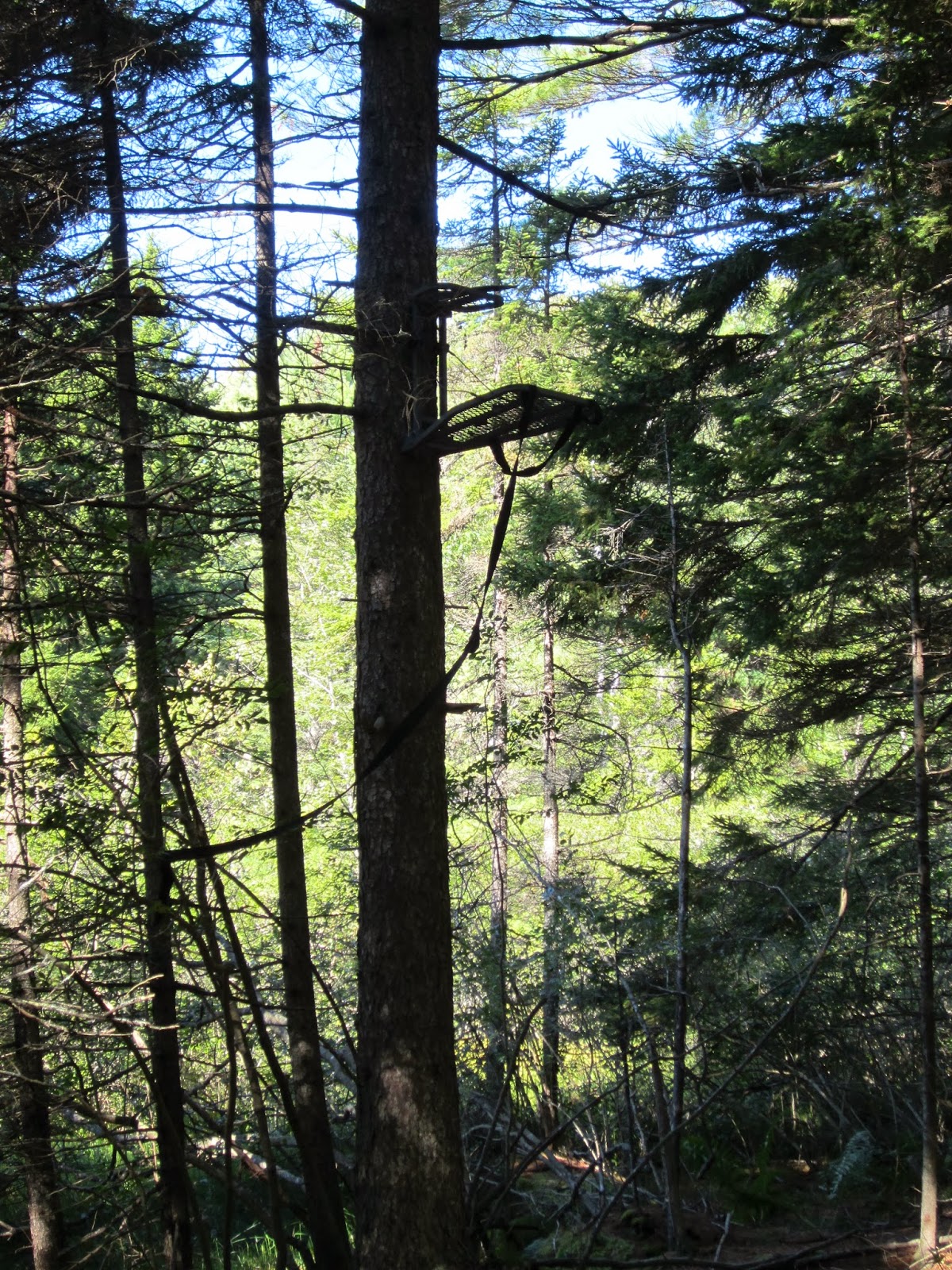
            I live on an old farm in Maine.  It has ‘land’.  Acres and acres of ‘land’.  “Woodland”, ‘forest’, “WOODS” and ...prime deer hunting ‘property’.  There are four ‘deer stands’ “IN” the “WOODS” this morning as I write.  A ‘deer stand’ is the modern made sporting goods ‘store’ purchased ‘assemble yourself’ metal ladder with-a-chair (“seat”) at-the-top that is “HITCHED” to “ A TREE” by the ...deer stand placing (note that last word and my former usage of it in this tale) hunter who... very consciously to their ‘best ability’ (a subject one does not define out loud of one’s ‘fellow hunters’) choose ‘their spot’ and ... once ‘placed’, goes up to the top and ‘sits’ in the chair (“on the seat”) and waits... for a deer (preferably a ‘large ten point buck’) to happen by for ‘him’ “TO SHOOT”.  Simple enough and my woods is constantly full of men in trees sitting on their “seat” (in more ways than one) even in the... rain and/or snow.


            It takes us no stretch to understand that Helen’s “I’m a deer” means that her hunters... in their deer stands... ARE... the lawyer, the bank, the Savage estate, the... soon to arrive... historical society... and ...me.
            “YOU HUNT DEER don’t YOU.”
            “Ah...”
            I guess I do... if one means as a professional antiquarian I am HUNTING TO KILL... old Maine sea captain’s mansions of ... attics full of the... untouched, undisturbed ... “profuse litter of indescribable old rubbish” “like that of the Evil One, dimly revealed through the cobwebs” (Melville in Part Six [C]).
            I have always felt that a deer hunter sitting on his seat up in a tree in his deer stand... in the rain... looked like a ‘dumb ass’ so... to find my self person accurately deduced by Helen to BE one of those deer stand seated ‘dumb ass’ “I can SEE the HUNTERS COMING” wasn’t really the best direction for my (self person) image to be... WHAT?
            Well... not much has really happened to ME at this ‘estate call’.  I mean... I’ve got about three hours into this... sat in one room talking sort of about some antiques sort of... about those in sight... after (and back home again) driving through scenic and ‘right side up’ Maine (New England) and... only NOW have been cell phone telephoned by the OTHER ‘dumb ass’ ‘seated’ in THEIR DEER STANDS ...perfectly contentedly... the lawyer, the bank... the historical society... ‘she’s a ten point buck’ “if you know what I mean”.
            Each telephone call from each other ‘in stand’ hunter drew THAT picture... ‘if you know what I mean’.  And THAT PICTURE was the same as what Helen had said: “They sit down there in BOSTON smacking their lips and rubbing their hands together”.  In their deer stands.  And me too?
            Pretty quick it became ME TOO:  “WE”.
            “Want you to, boy... go back to the TRUCK and get the pry bar and come back here and pry these OLD GRAVESTONES out; just pitch them OFF toward the SEA... so we can GET OUR LAWN TRACTOR IN HERE.” (Part Six [D])
            “Oh....me in there (the Savage estate)... in there to what?”
            “Clean it out”.
            “Out?”
            “Trophy buck.  You understand?”
            “Ah...”
            “Just let us know what you find”.
            Was I suddenly finding myself ‘beyond’?  ‘On my own’?
            Was Helen and the Savage estate being ‘turned up side down’?
            By me?
            But the front steps were still right there... with the top step and it’s old rusted wrought iron curl decorated boot scrappers (Part One)... still... right there.  No one had ...turned them up side down and pitched them to the side (Part Six [A]).
            I hadn’t even SEEN the attic.
            I hadn’t even been out of ONE ROOM.
            Nothing had been rummaged... ransacked... looted or carried off.
            No one was ‘in there’ or even ‘not know of this’.
            The Savage estate was ‘forgotten’.
            Except by four deer hunters sitting in their carefully placed deer stands.
            Five hunters... if I count myself.
            If... I do that.
            To DO that... I would have to... place... a deer stand... consciously, by myself... and climb up into it... myself.
            But Susannah ‘placed’ her “Indian Stones” her self... as a MEMORIAL ...to herself. (Part Six [B]).
            Right?
            There still there... right?
            After the four telephone calls I realized that in the Savage estate... I was ‘beyond’, ‘on my own’ and ... “better think about this.”


Friday, November 8, 2013

Coy - Part Six - New England Turned Up Side Down - (D)


Coy

Part Six

New England Turned Up Side Down

(D)

            One word I used only once at the beginning of this chapter (Part Six- New England Turned Up Side Down – (A)) is ‘congested’.  I turn attention to this word.  New England, after discourse on rummaging, ransacking, looting.... with additions of ‘pitched’, ‘right side up’ and ‘up side down’... is... too... congested... now.  This state of congestion INCLUDES all of the previous discourse and all of that all (pitched gravestones, et al).  It is the force that eases ‘forgetting’ and camouflages ‘not knowing about’.  It is the paved parking lot of New England with the rest being... ‘run off’.  Congestion is the increasing density of... New England.  It is the packing in, piling on, putting in, pushing back, clearing away, opening up, constructing, building and... cul de sac circle ...establishing of the progressing and fluid borders of ‘progress’ that are... moving NORTH ‘into’ New England.
            Do we all know what we are experiencing... or must I present selections on platters for a reader to ‘graze’?  How about... ‘it is’ the Black Dog of the Cape.  The new port of the old port.  The historic parking garage.  The condominium complex in the ‘low land salt marsh’ that ...has the same view of the sea Winslow Homer had... when he died.  The ‘new services’ most often noticed as ... lawn care and landscaping utility trailers towed behind title emblazoned ‘trucks’.  The strip-mall-esque drug stores, dollar stores, franchises and their green sign ‘next exit’ ‘services’.
            The outlet
            Concept
            Green sign exit
            Too.
            The parking lots that are the surround ...and sound... visual plateau... with white and yellow lines designating space that ANY old village’s elected fence viewer may STAND ON.  In the drainage ditch at the edge of ...so many of these ‘lots’... I spy the cluster of cattails growing ‘there’ ‘in spite’.
            IN SPITE.
            “There is a chemical spray we use to kill that.  Comes in a plastic jug”.
            The men in the truck towing the lawn care equipment sent ‘the boy’ back to that truck to ‘fetch’ the ‘pry bar’ they used to ‘pry up’ the gravestones at the edge of... the continent of North America.
            And is there... headless horsemen empowering... and empowered by... ‘all of this’ ‘congestion’.  Yes there is.
            It is big and white in my rear view.  It used to be black or ‘charcoal’.  Now ‘white’ is, apparently, the choice.  It is the big and white SUV traveling the former cow paths of New England.  “She’s driving”.
            The interweave; the tying back upon and weaving in... of these cow paths creates a web of narrow twisted meandering curved NIGHTMARE of foot-to-brake ‘road’ now traveled by ‘over kill of power to say the least’ top heavy, tinted window chrome grilled blond haired sunglasses step on the gas “suburbanized” zombies... in the rear view.
            “Where did you put that box of your grandmother’s china?” her mother asked.
            “OH... I know... IT’S out in the GARAGE on the STACK of stuff by the whatchamacallits”.
            Helen addressed ‘congested’ directly during our first meeting: “Oh my God I say; it’s OVER. .....  I know that look.  I don’t wish upon a star anymore.  I can’t.  She gave me a cell phone.  That is what means something to her.”  That notice of ...congestion... in New England... becomes Helen’s greatest personal observation for her role in the Savage estate.  Helen, when I met her, already understood the enemy and that the Savage family estate could not survive the ...attack.  I understood this when SHE first said it.  SHE, as our first meeting progressed, understood that I ...understood... this... too.  I also understood that ...although taking a considerable amount of time to accomplish... the destiny of the Savage estate was to ‘fall back and then fade away”.... into the forests of (Northern) New England.  To ‘fall back and fade away’ is the English ranger’s primary ‘encounter’ tactic used in the Colonial Wars when confronting the French and Indian war ‘forces’.  Roger’s Rangers not only perfected the tactic but ...wrote it down.  Too.  Confronted by congestion... New England... is... ‘falling back and fading away’.  Should one know this it is best to not ‘forget’ it.  “Not knowing of” is the pervasive and dominant ... ‘whatchamacallit’.
            The way this is working is by a turning of Colonial New England... up side down.  During the era of the Colonial Wars, New England interior settlement; settlement away from ‘the coast’... evolved as single ‘families’ traveling one bit further past ‘the last (dirt floor log) cabin and ...making their ‘the next’ log cabin.  This process was toward the ‘north-north-west’.  The French and their Indian allies came from that direction and traveled... south-south-east in their effort to... by ransacking, looting, burning, killing and scalping... ‘drive’ the English settlers ‘back into the sea’.
            The English response ...by the 1750’s... and as a result of a full century of ‘conflict’, was to successfully encourage the construction of ‘a line of frontier forts’ across the north-north-west settler’s border as a... moderately unsuccessful obstacle to ‘slow’ if not ‘stop’ the French and Indian ‘raids’.  From Coastal Maine’s Fort Western at Augusta, Fort George at Brunswick across to Charlestown’s No. 4 on the Connecticut River then over to Fort Massachusetts on the Housatonic at Williamstown... they did this; make a ‘line’ of ‘forts’.  Some of these forts were not only ‘a bit remote’ but ... didn’t have... many ... ‘there’.  That is an aside from the obvious ‘just go around them’ tactical ‘advantage’.  Surrendered after being surrounded and starved out... also... ‘worked’.  Who cares; that’s not what I am looking at.  I am looking at the notion of this ‘line’ of forts ‘on the northern border of Colonial English New England... to ...protect... its settlement.
            To protect; a forlorn effort that DID take place.  Turned up side down, I find a NEW ‘line’ of ‘settlement’ coming north from the ...south-south-west.  The ‘new line of settlement” is the boundary of the... ‘establishing of the progressing and fluid borders of ‘progress’ that are... moving NORTH ‘into’ New England’; the boundary of congested New England.  Traditional... and picturesque... New England has a new ‘line of forts’.  The line drawn by I is from New Castle, NH; the 17th century island buffered from the congestion found at Newington, NH, et al, by ‘historic’ Portsmouth... diagonally south west to the Concord, MA ...area... then west-south-west to ...Kent, Connecticut.  Kent is on the same north-south line that Williamstown’s Fort Massachusetts once was.  It is ‘Route Seven’
            Route Seven from Williamstown south to Kent is a spectacular scenic PRIVATE ‘forgotten’ or ‘not known of’ New England drive that even includes old style urbanity (downtown Pittsfield), New England authors’ homes (Melville and Hawthorne), mountains, rivers, bridges, riverside vista, side road diversions (Ashley Falls below the Stockbridge-Lenox-Tanglewood-Gendale aside TOO ...amongst this over blanket (quilt) of a ‘New England’ route.  One is... IN New England... right side up... all the way to Kent.
            After Kent; a scant few miles south of ... Bull’s Bridge... the congested New England (the Wilton-Ridgefield etiquette... with this spawn edge before its east-west [into NYS] and ever more horror show grade southward ‘to the sea’) ‘wins out’.  Kent... is the border fort of New England ‘left’ at the this ...end of the line.
            The original line of forts understanding was that ‘above’ the Colonial fort line, one was ‘beyond’ the settlements and ‘on your own’.  So... when Susannah was taken captive and ...Indian trailed north... she was ‘beyond’.  When she went into labor at Knapp Brook she was ‘on her own’.  When she went into the small bark covered hut the Indians made for her a half mile up Knapp Brook... to give birth to her fourth child... she was on her own.  She was twenty-five years old... when she gave birth in a ...bark covered ‘wick-up’ hut... beside a brook in the... wilderness.  Should one have found oneself THERE, on August 31st, 1754, and lifted the bark door flap, one would have seen twenty-five year old Susannah inside.  She would not be wearing a popped collar polo shirt and a pair of “go to Hell” ‘Nantucket reds’ pants.  She would have been wearing no pants at all and... told the peeking visitor to ‘Go to Hell!’.  Dropping the bark flap back down and reflecting on what one just saw ‘inside’ the hut, what one now saw; the bark flap door of the hut and what one was just told; ‘go to Hell’, one, logically, would conclude that ONE SHOULD GO TO HELL.
            When one goes below Kent, Connecticut, New England... ‘goes to Hell”.  Below Kent... New England is ...fully... ‘congested’.  Above Kent, New England is fighting back by ...falling back and fading away.  IF one lifts the flap and peeks inside this ‘fighting back by falling back and fading away... one gets told to... go to Hell.  JUST LIKE Susannah said when she was ...on her own... above the settlements... in a hut... by a brook... with no pants on.  One should never forget this ...quality... of New England... EVEN IF one is driving a big white SUV ‘too fast’ on old cow paths and ‘don’t know of this’.

Wednesday, November 6, 2013

Coy - Part Six - New England Turned Up Side Down - (C)


Coy

Part Six

New England Turned Up Side Down

(C)


            New England stone... and stone work... and their movements (disturbances?)... catch my eye.  Even single stones...; I’ve watched single stones for decades.  I am very careful about ‘disturbing’ a stone.  I have learned (taught myself) that in the region of ‘very early’ New England a stone could have been ‘placed’... just like Susanna Johnson ‘placed’ her stones.  I have learned... too... that ‘very early’ stones once placed... can and have been ‘pitched to the side’... just like the gravestones were ‘pitched’ to allow a lawn tractor to ‘mow the lawn there’.  The most endangered stone... is the stone that... someone CAN move.  Not only does that mean it CAN be ‘pitched to the side’ but it also IS MOST PROBABLY the MOST LIKELY ‘size’ of a stone originally ‘placed’.  The size creates ...and compounds... a heightened level of placing and pitching... a ‘most at risk’ group.
            A friend of mine ‘hunts’ “old Indian camps”.  He says he’ll catch a corner of his eye on a spot he happened to be driving by and... from then on ‘watched’ that spot, just as I watch a stone... “every time I’m going by”.  “One day; sort of the ‘right day’, I’ll stop the truck and walk down to the spot.  I can just FEEL it” he says “They had a camp there.  I can just FEEL IT.”  That’s the way I am about stones having been ‘placed’.  And... ‘placed’ and then ‘pitched’.  I can JUST FEEL IT.


I’m the same way about attics; about estates and their attics.  I can ‘just feel it’.
            As I stated previously... New England attics have been rummaged... ransacked... looted... and... ‘had everything taken out’... for hundreds of years before I was born.  Just like Susanna’s stones...- she put them ‘there’ and two hundred years later they are still being fussed with even though they are ‘forgotten’, ‘not known of’ AND ‘pitched’-... for two hundred years AND LONGER... an ‘attic’ that I ‘want to get into’ has been under siege.  Finding New England garrets that are ‘untouched’ and ‘undisturbed’ is, for I, a life long fixation.  The very vast majority of garrets in New England... have already been ...turned up side down.
            This attic moment recalls us to the Savage Mansion and... that... obviously... as I sat ‘there’ with Helen... MY inner fixation was ...ACTIVE of thoughts about the Savage mansion’s attics.  NOTE the plural for ...there has to be more than ONE attic in ‘that place’.  MORE adept ...did one notice... that I was already gleaning (as in Millet “The Gleaners”) the field of every utterance from Helen for ANYTHING slightly suggestive of ‘attic’?  The mention of the (Part Four) ‘his college trunk’ ‘untouched’?  Or ...didn’t she say that SHE had... rummaged it?  And it is WHERE?  THE ATTIC?  See:  I am on the job when it comes to old New England attics... turned up side down.
            Not one to let an old attic; an old New England garret, be LESS than a life long fixation, I have a ‘necromantic’ necromancy that I ...have... STUDIED as a ‘coy façade of fabricated myth’ about New England; the New England attic:  I’ve studied that and COLLECTED ...the very difficult to find... written references to, of, about, being in and ANYTHING... AT ALL... I could find.  And saved it.  And remember it.  And study it... usually over DECADES of time... for why would a passing sentence make sense to I at first.
            Written reference... to old New England attics, particularly anything not ‘in passing’ and/or ‘vague’... from over the centuries is... RARE.  Am I looking for a treasure map.  Not really... ‘just curious’.  The little references of garret once set off another man whose tale I wrote down:  (Can B. Worth, Feeding the Birds, Part Five).  Worth exhibited an old bed warmer to show what ...Mark Twain’s Huckleberry Finn ‘snaked’ from an old attic:

“…hid away up garret with a lot of other old pots and things that were valuable, not on account of being any account, because they warn’t, but on account of them being relics, you know, and we snaked her out, private…”
                                                            Mark Twain, HUCKLEBERRY FINN, NY, 1884, pg. 322

            Young Mr. Finn... rummaged and then ‘carried off’.
            I have hunted for references such as this for decades.
            They are often... precious;
            These records
            Of
            The rummaging,
            Ransacking, looting and
            Taking out...
            Of attics.
            They are the scant and skimpy records of a very ‘coy façade of fabricated myth’ that IS New England.


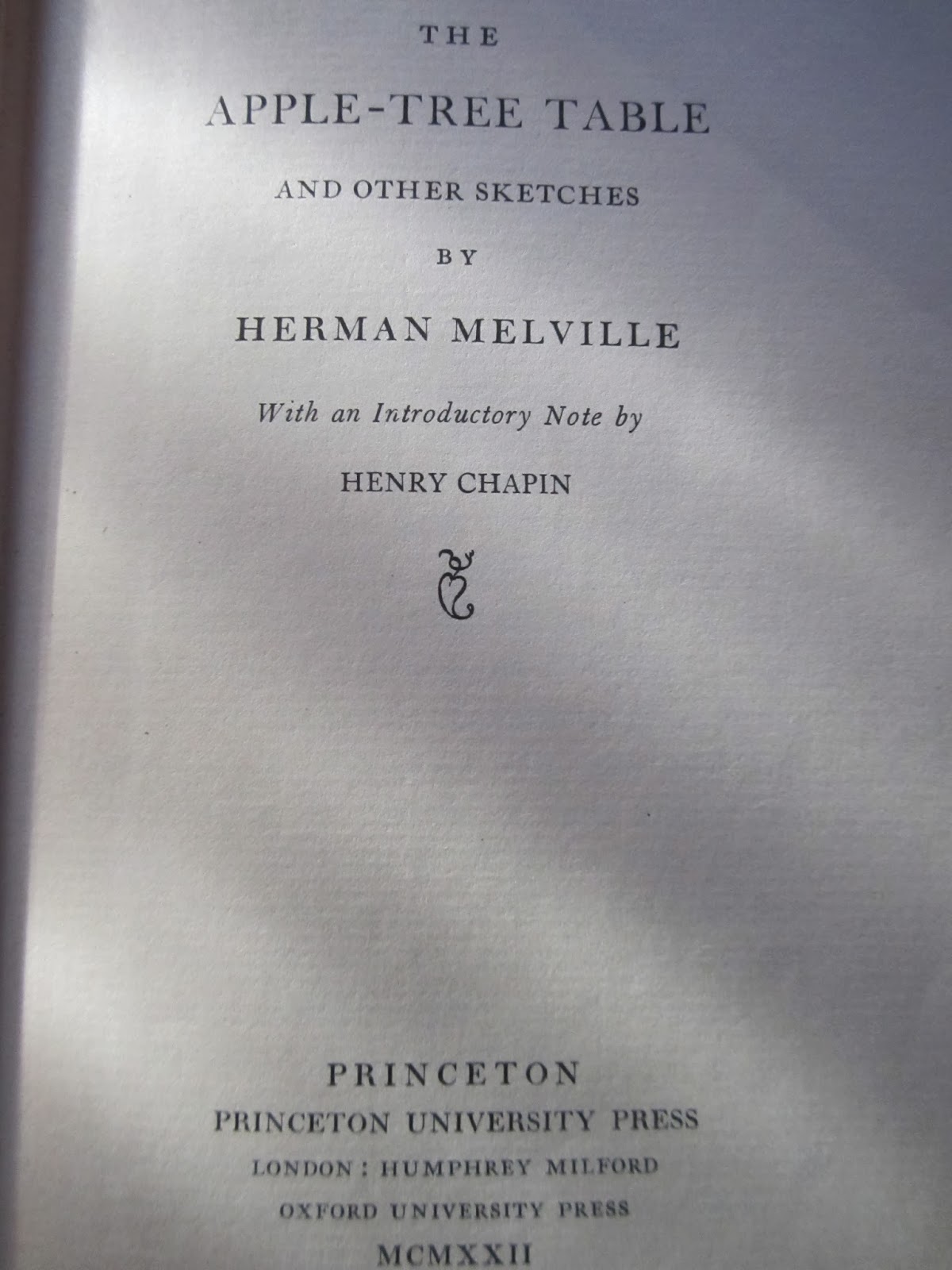
            Herman Melville passed such a scant and skimpy to me.  I pass it on, too.  It is a precious record to me foremost.  His short story; “The Apple Tree Table or Original Spiritual Manifestations” (Princeton University Press, Princeton, NJ, 1922, pgs. 9-51 with pgs. 9-15 being referenced here) has the charm of the story’s narrator being in a garret for the first six pages.  It is “a very old garret of a very old house in an old-fashioned quarter of one of the oldest towns in America”.  This narrator, with substantive detail, describes the garret and the contents... in a little TOO ‘dusty and dirty’, ‘spiders and creepy’ and dark and “goblins aloft” prose.  His “rusty, iron-bound chest, lidless, and packed full of mildewed old documents” amongst the “profuse litter of indescribable old rubbish” “like that of the Evil One, dimly revealed through the cobwebs”...:  Get a grip.  It’s a Colonial era attic that ... that... IN IT...            he finds a table (“I was pleased by the discovery that the table was not of the ordinary mahogany, but of apple-tree-wood”) and ...an old book (“a ghostly, dismantled old quarto” “Cotton Mather’s MAGNALIA”).  THESE... he... not only ‘loots’(“removed below”) but “had the dislocation of the one and the tatters of the other repaired”.  This last means that in addition to looting the attic, he ‘messed with’ and possibly ruined... what he purloined... in my opinion as a professional.
            In my opinion as a professional too... this whole six pages of Herman in the garret... IS a SPLENDID specimen of the ‘coy façade of fabricated myth’ that IS New England.  TOO:  Rummaging, looting and MORE... of, in and FROM a NEW ENGLAND attic.  The rest of the story... and that is quite a long rest of the story... has NOTHING to do with the garret.  The rest of the story... is an insipid... letdown after his ‘I’m on the edge of my chair seat’ in-attic opening.  For I.  The rest of the story involves, due to the warming of the purloined table, old insect eggs hatching with the bugs creeping out of the table’s... apple tree wood... and the chaos ...for each character of the household... that this creepy crawling creates.  The best support for the accuracy of the garret visit record (circa 1850’s) is its ‘in passing’ walk through expostulation followed by having no mention ever again:  Herman’s old New England garret is a record of ...just the way it is suppose to be.  Is it right side up?  Or did Herman turn the garret upside down; pitch it to the side and... ruin it?  And is this garret ...still there... although ‘forgotten about’ and/or ‘not known about.  I’ve never had ANYONE speak to me about Herman’s garret... or even the apple wood story... so... it certainly is ‘not known about’ with a chance or two of ‘forgotten about’.  But it (the written recording of the garret visit) is ‘still there’.  I feel the whole story is truly New England up side down:  The best part is the first skimpy and scant six pages ‘buried’ ‘face down’ under the ‘rest of it’.


            It is Herman who gave me the “necromantic” (pg.9, the first page of the story, first paragraph, line six) I appended to my use of necromancy (this chapter, paragraph six).  My single word was pilfered from Poe for... the ‘necromancy of attic (garret)’. (Poe; necromancy of female gracefulness).  The addition of Herman’s necromantic, by my active coupling... better reaches the true state of the ‘coy façade of fabricated myth’ of the old New England attic... undisturbed.  It is a spirit rope tied back upon... and often woven into... itself. One will find all this clear when one is actually IN that true New England attic.  Otherwise this spirit remains ‘beyond the reach’ of one’s finger tips.  It is not found in an old New England attic that has been... turned up side down.


Monday, November 4, 2013

Coy - Part Six - New England Turned Up Side Down - (A-B)


Coy

Part Six

New England Turned Up Side Down

(A)


            If one takes the top ...rough cut granite... step... with the boot scrappers at each side (Part One)... OFF the steps to the Savage Mansion’s front door... and pitches that step to the side... upside down... so the wrought iron boot scrappers ...with their wrought iron curls... are buried in the ground... these boot scrappers are... still there.  They are, still, coy and understated.  In one’s thoughts of New England, it is a ridiculous judgment for one to forget this.  Or not know of this.  Those that have the privilege of ‘forgetting’ are a much smaller group than those who... ‘not know of this’.
            Rummaged, ransacked, looted and then congested, New England, as a pure strain of being; as a meditation, as a black hole and... as a coy façade of fabricated myth... still is.  Even buried upside down.
            Rummaging, ransacking and looting were at the Battle of Lexington and Concord.  The ‘coy façade of fabricated myth’ may easily be found by the memorialized ‘bullet holes’ on ‘original’ buildings along Battle Road.  These features, too, had already been active in the Colonial Wars.  Deerfield’s Indian House door, looted from it’s house... smothers all.  By the 1850’s, as industrialization ‘took over’, rummaging turned fully to ransacking and looting; everything was ‘taken out’.  Thoreau, for example, ‘collected’ and ‘donated’ (to local museums) ‘old things’.  Some of his donations were, later, looted (‘lost’, stolen?).  The garrets of New England were under siege for nearly two hundred years before I was... born.  What could not be carried off remains as an austere permanence.  If it was wood... it was painted white.  Over and over.  “Stone” was ‘left alone’ most of the time.  Gravestones though... were fair game to either ‘rub’ or ‘carry off’ under the guise of ‘art’.
            The cruelest ransacking of ...gravestones... I’ve personally ever discerned... was at a ‘head of the cove’ ‘teardown’ shore front property.  The new mansion... of the new mansion sort ...that are not real mansions but do... ‘cost a fortune’... went to the ocean’s edge and that ‘went to’ carried a slightly raised and small ‘point’ that overviewed the whole stretch of ‘view’ ‘to the (Atlantic) ocean’... from what was once a very sheltered spot... that additionally included ‘salt hay marsh’.  My ‘from personal study’ reaction to such spots... on the once VERY Colonial Maine coast is... “settled early”.  VERY EARLY.
            AT THIS small POINT of land the owners had carefully ...and with the guidance of ‘shore front regulation’ exposed the point so that they could access the land in a ...lawn and landscape fashion.  They could, using gasoline powered ‘riding’ lawn tractors, ‘mow’ to the ‘edge’.  Except
            For.
            “These rocks
            That are
            Buried
            Way out here
            That we
            Keep digging
            Out
            See
            There’s one.”
            “We wondered why someone put them there?”
            “Gravestones.” I said.


            Yeah... on the early ones... always nearest to the edge of the CONTINENT of North America... they, ah... didn’t carve... names on them.  Like... you know?
            I’ve never been back there and have never found out ‘what happened’.  It looked to me like they’d ‘dug up’ about six and pushed those ‘dug up’ closer to ...the sea AND had about six or seven they... “hadn’t got to yet”.  The ‘point’ was a grown over... for centuries ...AND CENTURIES... sand dune so ‘easy digging’ and a ‘deep enough’ for burial... so, including the setting and view... a ‘fabulous spot’ to be... buried.  AND have, two or three centuries later... one’s ‘stone’ ‘dug up’ and pitched to the side ‘up side down’.  Actually... these earliest gravestones do not really have... an up side down.
            I routinely spy ‘good spots’ for these early stones ‘to be found’.  On the Maine coast the setting emphasizes SHELTERED, settlement (of one or maybe two ‘families’) early, EDGE of the CONTINENT, ‘look to sea’ focus, ‘good digging’ and ... ‘beautiful spot’ to build
            “A GOD DAMN PIECE OF SHIT OF A HOUSE WHO DO THESE PEOPLE THINK THEY ARE!!!!”
            Said my eighty-four year old then... and now dead... neighbor ...after... we’d ‘returned to a grave site we formerly picked blueberries ‘behind’ (back from the shore) but now no longer could due to the building of the ‘luxury shore front home’ that ALSO included... weed whacking the former blueberry ‘patch’ into... the oblivion called... “our lawn”.
            Are these gravestones still there... even after some being dug up and pitched toward the sea?  Are they forgotten?  Are they ‘not known about’?
            Are they ...up side down?


Coy

Part Six

New England Turned Up Side Down

(B)


            Trying to get away from being mentally chased by old gravestones when in the black hole that is New England turned up side down is... difficult... for gravestones tell little of their own tale.  To find a tale that has, at best, a close approximation of gravestones AND has physically been ‘turned up side down’.... AND... is ‘still there’... AND ‘is forgotten’ and/or ‘not known about’... has happened for I.
            The so titled “Indian Stones” south of Felchville or Reading, Vermont is this ‘happened for I’.  Two; one small, one large, Colonial style gravestones may be found roadside (VT route 106 at Knapp Brook) ...set in cement (so they cannot be ‘carried off’)... with a cast metal plaque ‘explaining them’.  They are not actually gravestones.  They are gravestone shaped memorial stones... PLACED by the original principal of the event they are a memorial for.


            Susanna Willard Johnson placed these two ‘gravestones’ at this spot FIFTY YEARS after... on August 30th, 1754... being ‘captured by Indians’ about thirty miles south at Fort “Number Four” in Charleston, NH.  While being taken to Canada to be sold she left the party and traveled half a mile up Knapp Brook to give birth to her fourth child in a small hut the Indians made for her.  She named the child Elizabeth Captive Johnson.  The child survived.
            I am not writing about this captivity.  Johnson survived, her husband died, she returned to the area, married again and had seven more children.  By the end of the century her reminiscent narrative of her adventure was first published.  She died in 1810.  Shortly before her death; 1806-07, she... SHE... had made and... SHE came to the base of Knapp Book and SHE ...placed... THESE two ‘gravestones’ ...with their sketchy text and curious ‘Indian’ style decoration... to be her memorial to HER experience at this spot fifty years earlier.  I do not know where Ms. Johnson’s actual gravestone is ...but I do know her memorial stones well.
            Originally stuck in the ground beside the road like gravestones, they were well known through the first century after ‘she placed them’.  Concern for their preservation ...and to prevent ‘looting’... shows that her family cased the stones in cement in “1918” and, evidently ‘moved them back’ for the road at Knapp Brook was ‘improving’.  In the cement block they have remained but this block has been shifted around (“back”) by the highway department ‘as needed’.  Today they are set back far enough from the road that they have their own small ‘turn out’ so ...people such as I... may safely park and view the stones.


            I have driven by the stones for ...gosh... OVER fifty years... after ‘discovering them’ through my parents.  I have never seen or encountered ANYONE looking at the stones... ever.  I have seen ‘a million’ cars and trucks ‘go by’ ‘at fifty...five to... sixty... ‘all the time’ when ‘I stop’.  Once I talked to one man once who knew about them.  He lived in the area and is... dead... now.
            North of the “Indian Stones” one drives through downtown Reading.  It is as undisturbed as it appears; no makeover, rediscovery, renaissance, tourist destination or commercial upgrade is... there.  Reading is ...New England... up side down... but ‘still there’.  Slowing to ‘thirty’... maybe... is the standard visitor’s ‘visit’.  Up over the pass... northward out of town ...and then downward from the pass... one ...curves through at thirty mph ‘South Woodstock’; a village where things are ‘kept up’ AND equestrian venture capital is ‘deployed’.  Too.  White is painted white.  Federal bricks are brick read-red.  Shutters square, the homes ‘detailed’.  The stone walls are ‘nice’.  Further up the route one reaches it’s end in Woodstock.  The Common is in front of one at the route’s end.  The Woodstock Inn is to the right.  Most everything white has been painted white... over and over.  The stonework is not only ‘left alone’ but is ‘nice’.  Many of the front door stone steps have old wrought iron boot scrappers painted black... at each end.  Some have coy decorative wrought iron curls.  It is the way New England really is... because it is the way New England really was... and... really is... when New England is... right side up.


Thursday, October 31, 2013

Coy - Part Six - The Savage Fortune


Coy

Part Six

The Savage Fortune


            I set Aunt Minnie’s glassware down... on the floor by my left foot and... received a verbal shotgun blast of a family tale from Helen... that was actually more substantive, more revealing and ...proved over time... more accurate than I normally garner from this... rather frequent in my line of antiquarian work... ‘family saga told’.  Although not rehearsed, it was clear to my ear that Helen had pontificated the tale... many times before it reached my ears. 
            “MY great, great.... great... OH WHO CARES GRANDFATHER was JOHN Horatio SAVAGE.  ‘ONE John’ they called him.  Also ‘HICK’ or ‘Hickey’.  He was from Shapleigh (Maine).  The Savage family had a farm up there.  Maybe it’s OVER there.  Anyway.  He ran away from home.  Actually; he didn’t run away.  He just left.  He was only seventeen or something.  He went to Portland and got a job on a boat to BOSTON.  Then he went down to NEW LONDON.  ON a WHALE BOAT.  Maybe it was on a whale boat FROM New London.  Anyway.  It was a whale boat and he was on it.  Just this farm boy.  Went to sea on this WHALE BOAT.  They were gonna be gone FOUR YEARS or something.  So there he was.
            “FINALLY they found some whales and killed them.  They’d tie them to the side of the boat and cut them up to haul them up on to the boat to BOIL them into OIL.  WHALE OIL.  They’d put it in barrels.  ONE John didn’t know anything about this; he’s a FARM boy.  So they said to him to go down over the SIDE of the boat and stand on the whale and CUT IT UP.  Well what did he know about doing THAT.  NOTHING.  So he’s down there with these sharp cutters on poles and he starts cutting that WHALE up.  And no one says anything to him or how to do it or anything.  So he cuts that whale up just like he cut ICE on the POND at the FARM in Shapleigh.  He’d cut off this long square sheet and they haul it up onto the boat deck and BOIL IT into OIL over the FIRES on the deck.  He didn’t have anything to do with that; he was down STANDING on the WHALE.  SO he did that EVERYDAY for months; any time they killed a WHALE he stood on it and cut it up.
            “So one day after about a YEAR he goes to the side of the boat to go down and stand on the whale and cut it up.  But when he gets there; to side of the boat, the second MATE is standing there in his uniform.  He say ‘One John:  TAKE this uniform and go aft and take a bath and put this on and come back here’.  So Hickey don’t know what that’s about but does what he’s told; takes a bath and puts on this new BLACK WOOL uniform and goes back to the side of the boat.  The MATE then says to him to STAND THERE at the side of the boat and TELL THE MEN down on the WHALE how to cut it up like the way HE’S BEEN DOING IT.  ‘Oh ME?” said One John.  ‘Yes YOU’ says the mate and ‘when it’s dinner time you come back and eat with US’ he says too.  So Hickey don’t know what THAT means either so he stands there at the side of the boat and tells the men on the whale how to cut it up.  Then he goes back for dinner like he’s TOLD TO.  Well he’s sitting with the CAPTAIN and the MATES.  The carpenter TOO.  He eats with them and does from then on.  AND he SLEEPS BACK THERE TOO.  They tell him to bring his chest aft and STAY THERE.  So from THEN ON that’s what he does; stand by the side and tell them how to cut up the whales.  And stays back with the CAPTAIN.  For THREE YEARS.  Then they go back to New London.  And he’s PAID OUT.
            “He goes home to Shapleigh to the farm and SEES everyone.  He has more money then they’ve ever seen.  He brings them GIFTS.  But he’s going back to sea with the whale boat to work just the SAME so LEAVES again.  And does it again just the same with this captain and mates.  He does that for eighteen YEARS with them.  THEN the WHALES are getting hard to FIND and also the other boats are STEAMBOATS now.  SO after all of those years they STOP hunting WHALES.  But NOW he’s PARTNERS with these men on the boat AND has saved his MONEY.  So these men are OLDER now TOO; older than One John.  So they say to him they have money and he does too so we are going to stick together and you can stick with us too and they get an OFFICE in a building right down town here and ....I’VE BEEN THERE SEVERAL TIMES to LOOK AT IT.  It’s FOUR FLOORS up in a building with FIVE floors.  Right on COMMERCIAL STREET.  There’s nothing there anymore.  IT’S EMPTY.  I just wanted to see it.  So I went there.
            “Anyway.  These five men with Hickey stick together in this office and bet their money on business deals.  BOAT CARGO, SEA VOYAGES and even WHOLE BOATS.  They buy and SELL BOATS.  All five of them at this table in that office.  All day except when they all went out for lunch together.  For YEARS.  And they did well.  REALLY WELL because they’d all been to SEA and understood the RISKS and KNEW ALL the CAPTAINS.  When the Civil War came they speculated on TOOLS and RAILROADS.  So One John sat there for rest of his life making money doing this.  He died in 1871.  Most of the others had already died.  He built this HOUSE for his WIFE MOLLY.  He made a fortune.  They even had their own BANK in Boston.  They MADE a BANK to put their MONEY IN.  That’s how come that idiot bank is in BOSTON NOW; they got their hands on One John’s BANK somehow.  I don’t about THAT.  I don’t’ know how they did it.  I’ve BEEN to the bank but it’s... you’d never know that it was STARTED on a WHALE BOAT.
            “One John and those first generations were different.  FROM the WAY I was raised.  I had to find out about Hickey.  I didn’t know anything about him.  THAT’S because after the money was MADE the family just kept it in that BANK.  There was always lots of MONEY.  THAT’S what Aunt Minnie would always say; ‘there’s lots of money’.  SHE knew how to SPEND it.  I known now... and Mama knew...where the money came from.  Hickey would never spend any money.  Only Aunt Winnie spent money.  SHOPPING in NEW YORK.  They’d take the train to NEW YORK.  And go shopping.  When I was young I went too.  It was fascinating; to be in New York.  And go shopping.  NOW things are different.  And THAT was different TOO.  I just don’t do it the way Aunt Minnie did.  I’d rather go to Florida and be with my friends.  I don’t really care about shopping.  This house is already full anyway.
            “I’m gonna tell you one more thing.  You already know about this.  It’s OVER here.  “This; this house, the clutter.  It’s not clutter.  You know that.  Eileen (the first appraiser, Part Two):  She didn’t know.  She didn’t know I have a bank in Boston.  She doesn’t know.  This; this is ALL CLUTTER to her.  Well... you know it isn’t.  And I’m gonna say right now that there’s a real lot of it.  I even got One John’s old BOOTS.  This family never threw ANYTHING out.  Well I WILL.  Some of it; it can’t be any good.  But BEHIND THAT; all that clutter.  THAT’S WHAT REAL.  That chair (she said gesturing at the chair I was sitting in).  That came from MOLLY’S FAMILY.  How do I know that?  Because Aunt Minnie told me it did.  EVEN SHE liked that chair the way it is.  Molly’s daughter made the upholstery.  You see; this is real here.  Not pretend.  NOT ARRANGED like Eileen does.  She’d put SEA lavender in that compote.  She wouldn’t know STEW-Ben from HAS-BEEN.  But if you told her... SHE’D TAKE IT.  Try to make it hers.  Special.  You can’t.  I know it.  YOU know it.  You can’t fake this.  That’s what makes this... even if you take it all to the DUMP...:  This is real.  You can’t go shopping and BUY IT!”


            I didn’t come back to see Helen for three weeks.  I thought it would be longer.  Actually... Helen was dead serious about... what she has continually called... “cleaning out”.  That was fifteen years ago and ...we... are “still cleaning out some more” (Helen’s words).  I have been ‘in there’ ever since this first audience (?) with Helen.  That day I took the olive dishes and pair of goblets home.  I told my wife the whole story.  “Maybe she IS crazy” my wife said.
            “I don’t think so.” I said.
            My wife is now used to my trips to Helen’s.  When I bought the teapots and green aperitifs (Part One), that was no surprise although she marveled appropriately at their ‘old sea captain stuff’ qualities.  Helen is also why she’d put the Eileen Fisher profile (Part One) at my place at the kitchen table.
            From this first meeting... to this day... as I write this, Helen has never pretended, teased or flaunted her estate to me.  She is not shy or reserved around me.  She makes decisions rapidly and follows through on them.  She bluntly speaks her mind on every subject.  I have never seen her act this way around anyone else.  To every other person Helen is the OPPOSITE in behavior.  No one but I, that I know of, has ever been inside Fort Helen and seen the... Savage fortune. The Savage fortune is NOT money or antiques.