skip to main |
skip to sidebar


 The other day I went to Goody to appropriate her kettles so I could take their photographs for this post. I could have used other kettles but I wanted hers. The usual "conjure" kettle was not in use, the "water kettle" (the kettle she keeps partially full of water "around" to "WHOM-i-FI" (humidify) with we dumped out. First she "I don't like it" and then she did like it and actually came up to the farm to "watch". The "watch" was poking around and around until my wife gave her a big box full of beets, carrots, potatoes and onions. Then she pressed for… and received… a small cabbage. "PAID IN FULL" for the photographs was she. She left. She drives. She drives a new Lexus.
Goody's kettles are both later, inferior made small kettles. The black fireplace kettle is the oldest, probably about 1800. It is heavier due to thick casting and has the typical bent wire handle of the era. It is not quite the low grade of a "trade kettle" for the amount of cast metal and slightly larger size lifts the quality above "cheap". Trade kettles were cheap cast, thin, light and small kettles that look good but quickly cracked under constant use. Goody's will last her whole life. Another small design notice is that the bent wire handle, when closely inspected, shows the handmade - hand forged qualities of this wire especially right around the bend at the handle eye. This, with the heavier cast, identifies an earlier kettle.
Her second "water" kettle is in the direction of the design demise of the original 18th century kitchen fireplace kettle. It is not all the way to the very badly cast, very cheap quality metal and clumsy form of the late 20th century 1950 - Bicentennial era kettles. (Since 1976, quality old style witch kettles have been revived and cast in small numbers so are real working kettles that "last". They are skimpy in number, a little awkward in form and very expensive "new". One may find one of these new ones "cheap" (or sort of cheap) by constantly hunting New England yard sales… but that will take a while.) This "water" kettle is good for what she uses it for and the life of it is extended by her NOT using it: She fills it with water, it evaporates, it sits empty until she chances on it, then the process repeats. Aside from the lightness of the cast metal, the manufactured feel to this cast, same manufactured feel to the wire handle, the quickest sign of the newness is that clean, large and crisp cast "ONE GALLON" on the side. Earlier kettles were not marked (especially this bold) and, as here, the print style of the marking looks like new lettering. As a nick on all of this; note that in the old days everyone knew what a gallon looked like. Today we like to be told.
Both of these type of kettles are the …most easily acquired… in antiques hunt. They move as a steady commodity from antiques shops, auctions and private sales. Keeping a vigilant eye, one may spy …and buy… one very cheap (a couple of dollars). Tagged in a shop, they are very high at $50.00 but do have a fairly regular move along price of $10.00. For use as minor decoration and for "WHOM-i-FI" water, they are perfect. If one expects to show their knowing eye of …an 18th century northern New England fireplace kitchen witch kettle… design… seek a real old one.

 In the early morning, in the dark, on my way out for my antiquarian workday, I pass a very old and very small home perched overlooking the sea. There always is one small faint light on. Goody is up.
"Goody" stands for "good wife", a colonial New England title of respect for the mistress of a household but qualified as having humble social standing. Goody Coffin has always been called Goody even though her true name Mildred Jane Coffin and she is of… high social standing.
She is in her sixties. She lives alone. She taught kindergarten and still occasionally does. She has always "fished"; engaged in the coastal Maine seafood industry in a very small private way. A few lobsters. A few clams. A few crabs. An occasional fish. She never married but has a reservoir of mostly younger male fishing industry employed "suitors" who are "always around" (her words). By age fifteen she spent her days along the shore around these men. "Where there is diesel fuel there are men." has been her life long mantra. This free approach has kept her in various states of estrangement from her family, the family home and the community. She does not care.
She rises early, always in the dark. She goes to bed very late but I am never up then so cannot confirm this. She always has the one small light except for once a year. That single day is Halloween. At dawn of the day she puts a small carved jack-o-lantern with a candle outside before her door. It stays there, lighted, through the dawn of the following morning. I see it once a year. One year, on the way home, I actually stopped to visit. I tapped on her door as the rich holiday smell of the candle burning the jack-o-lantern filled my nostrils.
She greeted me with a little cackle, flashing blue eyes, a gesture to enter, an about face that swirled her rag cloak. A rich smell of wood smoke and burning stew struck me. She has a colonial fireplace the dominates her 1740's home and confronts the front door. One steps into Goody's fireplace kitchen when one steps into her home. The fire blazed. The driftwood logs crackled. And… her small witch type kettle simmered before this; just noticeably bubbling. Though no meat was burning, the smell suggested "something is".
I stop occasionally so am no irregular visitor. My motivations have become friendship… with that being as much of friendship as Goody will allow for… she "doesn't keep friends". My original effort was commercial. Goody's mother had finally died, Goody inherited and part of the inheritance is the colonial family homestead of seven generations on the main street of a Maine coastal village that is… full of antiques. Not only was she not going to "sell" the family homestead… or anything in this homestead… she locked it up and has left it "just as mother died" ever since. She keeps the lawn mowed, the leaves raked, the shutters from flapping and the old lace curtains drawn. "Appearances" she says and then turns her back, in fact, on the neighbors, the town and the selectmen who would prefer a less haunted home. To the antiques dealer, the home appears as colonial New England gold.
We made small talk. I commended her pumpkin. The smoke and burning smell intensified. I looked at her simmering kettle. She saw me do this. "A conjure" she said. "It's burning?" I said. "No. Bones, bat wings and toad's eyes" she said. The air became even heavier. Goody's witchcraft is well known.
Within this haze the oddest feature of Goody manifested. It is very hard to keep a clear view of her for she seems, as one chats, to change in age. She floats before you ever varying in appearance to appear to be… quite young, then, as one blinks at this, to be craggy and wretched with age and, blinking again, the Goody one knows. It is an uncomfortable haziness that does not abate. It encourages me to leave promptly. She seems to know all this and cackle softly while flashing her eyes. That Halloween eve visit was so bothersome that I have never returned on that day again and prefer only daylight visits.
Goody's actual haunt on me is very simple. She will break her lockdown rule and purloin a "treasure from mother's" for me to view, critique and appraise. Each is never for sale. That is fine for Goody knows little about antiques and has… poor taste and a bad art eye. Cheap Victorian porcelain figurines appeal to her eye. A framed oil painting on canvas of her great, great grandfather's clipper ship in a storm is ignored. This results in my always, at least, being aware of where she is at with her mother's estate… and that is good. I guess. The only horror to this haunt is that… Goody will take things from the estate and USE THEM and… these are often actually good and even …very fine… antiques. Currently she has purloined "a table" that she is dragging around her home and using as a sort catch all cooking counter top next to the fireplace. If it were not a… fine turned legged northern New England Sheraton two drawer sewing stand with two birdseye maple drawers and retaining the original old surface, undisturbed… I wouldn't care. As it is, she and it are driving me crazy.
That Halloween eve, I stumbled backward to the door in the burnt meat haze. Goody was pleased for she "has an evening full of trick & treats" she said. I asked, foolishly, "What are you giving out?" She paused, her eyes flashed. "Oh… little cups of my BROTH" she said. "It's made with bones, bat wings and toad's eyes".



 The restoration and decoration of the colonial fireplace kitchen in a restored colonial New England home has, for 150 years, been the default end-user of the witch's kettle. Occasionally a collector assembles a row of, preferably, "signed American" (maker marked) kettles with a large size cauldron or two nearby. The next tier of traditional decorative impulse is to include a small kettle next to a …not a… colonial fireplace. From an antiques dealer's vantage, the door of selling an old iron kettle, a witch's or not, nearly closes with these options. There is one grand option left.
Though never mentioned, rarely noted and of foundation level northern New England decorative pedigree… the old witch's kettle has a most prominent …and understated "place" in a properly decorated traditional New England home; the front porch. Black… against white… it rests "there".
The front porch is in front of the front door and that door is rarely used because "everyone" comes and goes through the side door that usually enters the kitchen and is back up along the side of the home. Way out at the front of the home, facing the road, is the front door… and, usually, a "porch". A wreath is put on the front door during the holidays. It is taken down after the holidays. The whole porch is repainted every dozen years. A porch rocker or too, in dark forest green paint, may sit on the porch. Very, very occasionally someone actually sits in these. The only other acceptable decorations are… a modest - NEVER TOO MANY - gathering of OLD flower pots (no hanging baskets; they are a "new" taste)… with, usually, geraniums…and a single old watering can… maybe… and… a single black witch kettle.
It may be small, to the side of the door. It may be larger; at the side of the door, out at the edge porch between the pillars… or down near the end (acting as a sort of bookend). It may be a large caldron. Any are acceptable but the knowing eye seeks a true witch's form, a single kettle only and… black. It stays there forever. FOREVER.
It is so classic… so traditional… so, so, so… proper as decoration… that it succeeds by not ever being noted. It is so traditional that it vanishes… yet a knowing eye always denotes it. It is a signature of classic traditional northern New England good taste that signals that… this taste… continues inside the whole home. That's what it does; it sends that message.
Extended, any front door anywhere may attach this iron kettle signal. Simply get one and put it out there and …never touch it again. The job is done. Helping this kettle placement… and one's wallet… is a NOT DENOTED by the antiques marketplace …necessity. The kettle one chooses, in addition to witch form, is BEST if it is cracked or has a hole in it. Or both. THIS is to allow the rain & snow water to drain out. Otherwise the kettle will get full of water, water soaked leaves and …sit there full… for no one is ever out there except once a year to "empty it". This means that one SEEKS a cracked kettle and/or a kettle with a hole in it's bottom. THESE are considered flawed kettles by the traditional antiques market so… sell for less. Hundreds of dollars less. A cracked or "with hole" kettle may be found for $75. while it's perfect specimen are usually tagged $250 and up. One wants the water to drain out so one never has to touch the kettle ever while it sits out front "forever". A cracked kettle, to me as an antiques dealer, is by far more salable.
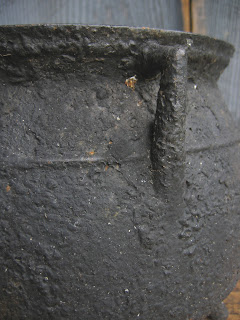
I have pictured a front door classic. It is a two gallon classic witch form with… MANY layers of black paint. When one paints the porch white every decade, one paints the kettle… black… too. I bought this one off a porch. It is cracked. It has holes drilled in it too. It drains perfectly. It is also missing it's handle. No one will notice but… THAT… FEATURE… even further reduces the cost of the kettle; ten to thirty dollars. But again, behind this all… is FORM. It must, must, must be a witch's kettle to be "right". This one is CLASSIC form and size and sooooo front porch ready… including the paint surface heritage… that it may be considered the epitome of one's quest.
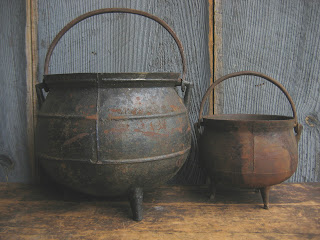


 It is the black color, the round shape, the three legs to rest upon, the flared top opening and the thick handmade wrought iron handle hooked into the cast eyelets that forms the silhouette of a New England witch cauldron. It must have that silhouette and must have it from a distance. “Kettle” or “cauldron” may be determined by size but the former is smaller. The witch kettle, in actual usage, WAS smaller. The fireplace kitchen became too congested with a true cauldron and …it took a lot to fill it. The smaller kettle form was the workhorse of the colonial New England fireplace.
The form, to the eye, from a distance, is crucial. It MUST have that round, plump and ever slightly squat form. The top of the kettle’s opening lip MUST flare at an outward angle. The kettle color MUST be (preferably) fireplace blackened or, these days, an encrusted black-brown-rust color. The three feet MUST be “tall” meaning having not been fireplace “burnt-off” or buried-in-ground rusted “down”. The thick handmade handle MUST be that and not a bent wire handle that became common even by the late 18th century.
Must, must, must or it will not be a true New England witch cauldron. One may find dozens of “almost” kettles. Dozens & dozens of later “not” kettles. And a hundred dozen of “NO!” shaped cast iron fireplace cookware “pots”, most with lids. No: These are not a New England witch cauldron. This is understood commercially in the antique community; a true kettle will always “cost more” and that price is determined by knowing eyes and their glance from a distance. If a witch kettle is not one by glance and distance… it will never be one.
In the photographs we show two together; a medium size two gallon and a smaller one gallon. Both are classic fireplace kitchen size. Both have all the proper “musts” so are true early New England witch kettles. The small one gallon DOES convey it’s form from considerable distance. We include photographs of the handles and handle rings, the legs, the kettle bottoms (with their distinctive early casting line) and again note the flare to the tops. No lid… ever. Fireplace cooks and witches were always adding, stirring and ladling out so never wanted to fussed with a lid.
The key to the mind’s eye vision of the witch kettle is to keep the northern New England’s… 17th century… costal, dark, remote, late autumn wind swept cold… merged with the primitive fireplace burning in the dark in the battened down homestead, hovel or cabin… next to a dark footpath in the wilderness and… these merged with… skulking Indians, lone night travelers, old withered, craggy, boney, living-alone women … and a ragged black cat …with glowing yellow eyes. If the kettle conveys all that… it’s a good one.


 The next post will be on October 29th or 30th. It has finally cooled off. The leaves along the pond have changed their color. Last evening my wife made a dinner of baked cabbage (with carrots and onions) and mashed potatoes, all fresh from our garden. They were joined by bratwursts and bangers fresh made locally in Lisbon Falls. It was a wonderful fall dinner.


 In a northern New England home… may be found one last form of cathedral pickle bottle; the pickle bottle lamp. This is an electric lamp made from an antique pickle bottle. The form first appeared in the 1920's, flourished through early 1960's and, as manufactured conversions, has been on decline ever since. The lamps themselves are not on decline. They command a premium.
In the most simple formula preferably two close matching ("a pair") large and tall and, preferably, cathedral style antique pickle bottles are… "drilled" (meaning a hole is drilled through the glass at center of the bottom) and "electrified" (meaning an electric wire with a plug on the outer end is run up through the hole to a mounted lamp socket at the top of the bottle. The pair of lamps are then divided and placed on side tables, most often at the sides of a sofa and used as "lights". "Everyone" "likes them" is their ever after.
Today the antique market place seeks high quality early conversions (pre-1965). Later conversions, due to collector appreciation of the pickle bottles and … the decline of the availability of high quality professional converters… are not as popular for they are a touch… tawdry. The better quality the old pickle bottle "drilled" (meaning tall perfect form and strong glass color destroyed for collector's by this drilling) mounted with a professionally done handmade quality base and lamp socket mount (that are difficult to "get done" these days for a craft person doing this work well are scarce)… and preferably a pair (thereby doubling all aspects)… the better or best. Late conversions LOOK like late conversions; a sort of cheap 1970-80 hardware casing around an often times NOT drilled pickle bottle (a cork plug socket mount). This last, with the dangling cord at the bottle top means "can tip over" as well as a "visible" cord. The former means "a cheap look".
One needs only brief contact with an early conversion to be ever able to sense those qualities and pass by the later conversions. This early conversion market is competitive and …ever nudging up… pricey. Today the cost of the actual antique pickle bottles merged with the cost of a fine quality conversion then "Mr. Wallet" again with a … quality lamp shade… easily establishes a base cost in one's mind eye that is prohibitive to execute. As the actual look of the lamps is New England home traditional-classic AND ever popular with even the least antiques eyed home decoration viewer AND has a strong salt and peppering of "old money" - "from my grandmother" too… the intersection of object and cost is well defined. The rule is… if one wants… and one sees for sale and… BUY IT. These early conversion are bought, used and stay in use for decades. MAYBE they "are sold" when "they die and they clean out the house". THEN they are promptly purchased and start that exact cycle over right away. The lamps don't appear at flea markets often. They usually are found in better antiques shops in …better communities of … better homes. Expect them to be priced accordingly. A blind luck find is stumbling on a pair inherited by a friend who "hates them" (meaning they "don't know" and have "bad taste"). BUY.
I had to scamper to purloin a pair to photograph. This pair is not an actual cathedral style pair but is the… very usual to encounter… octagon style with a fine late 1950's conversion that includes the hand soldered brass & wood base, the brass mounted socket at the top and, notably, a internal ribbed clear plastic tube hiding the steel shaft inside. This "pair"… although the color match is a little weak and the actual lamp shade height is slight taller on one… indicating that originally the pair was positioned separately in a home… is a very acceptable find these day. They are actually being used to decorate a trestle table… upon old oriental rug… in the center of a book collector's floor to ceiling bookshelf lined collection room. "Everyone loves them".
A classic cathedral pair in matching deep color would be "better" but this set is amplified by the notably fine old conversion. Even the …still works perfectly and are safe… old cords with their frayed covers… sends the "from my grandmother's" message very well.


 Between… Baxter's antiques picker find in Missy Adams' shed of the shelf of plain pickles together with the barn soiled cathedral pickle …and… Mrs. Abbott's very appropriate Maine coastal home decorative assemblage of three cathedral pickle bottles… one finds a third active critter; the old bottle collector... refined to the …old pickle bottle collector.
Generally young middle age males NOT decorative in impulse (excepting the intervention of "the wife") but outstandingly appreciative and sensitive to the "old glass" qualities of an old pickle bottle… the weight of their "Mr. Wallet" as collectors rests steady upon any cathedral pickle bottle. They "collect". They "keep". They "find". They "SELL". Constantly. Mrs. Abbott's three are their regular quarry. "Common" but "good", "saleable" and… "my wife likes them", these collectors defer to a select group within their number who actually …very seriously… "collect". Behind THESE collectors is a single book that guides them; "ZUMWALT", so stated.
Betty Zumwalt's KETCHUP PICKLES SAUCES 19TH CENTURY FOOD IN GLASS, Mark West Publishers, Fulton, CA, 1980 is THE reference book for old pickle bottles. Collector focused and comprehensive in scale, the tome obsesses to record every old pickle bottle there is, carefully describe it and, for most, crudely picture a specimen. The core of the book is an alphabetical compendium of letter embossed old (pickle) bottles. The NOT letter embossed bottles (such as Baxter's and Mrs. Abbott's) are given short space at end of the book. This does not diminish interest in these bottles or their value. For example, a non letter embossed AMBER colored cathedral like Baxter's, perfect, with a rough glass pontil… would be priced at six to ten thousand… or more and see very, very, very strong collector interest. (Mrs. Abbott's interest would be nowhere in sight.) Should that bottle be letter embossed… even more cash value. And even more, more; if that bottle be as described but NOT recorded by Zumwalt ("not in Zumwalt") and… (a must) be (uniformly acknowledged by all collectors without ANY qualifying) "AMERICAN"… even more, more cash value. But the word for this post is ZUMWALT.
Baxter knows "ZUMWALT" and did not need to refer to a copy for he knew that without letter embossing… his find had a DEAD SERIOUS cap on it's cash value. I did not need Zumwalt for the same reason. Mrs. Abbott doesn't even know Zumwalt exists and wouldn't care except to say something like "OH ISN'T THAT A NICE BOOK" if one ever bothered to show it to her. But: HER Mrs. Wallet is the one that …rests steady on the classic cathedral pickle bottles we have amplified in these posts. She IS the market top.
This book; "ZUMWALT". is valuable to these posts as a "should know about"; should know that the word "ZUMWALT" carries "must have" clout among old pickle bottle collectors and… know that the actual book is out of print, only found in the secondary market, sells for between $30.00 and $50.00, is high quality attractive hard cover in dust jacket and… should consider that the book may actually have an odd "Wow NEAT!" - one cannot go wrong - conversation starting - coffee table - back of the toilet decorative display value …in a northern New England home.