Monday, November 9, 2015

Canary Lustre - Part Two - "Confusion on the Mantel"


Canary Lustre

Part Two

"Confusion on the Mantel"


            It is difficult to... document... my last... dictate of New England Antiquarian fireplace mantel ‘old china’ decorum (Part One).  Considering Canary Lustre’s ...habitual... deferment to... AND... stoic yet ‘off radar’ flagged mountain top poise in Colonial Home New England... this ‘elegance and taste’...; it (documentation) should be around:  Until one reminds that I speak of the ‘before smart phone cameras’ vantage of the New England.  Et al.  It (Canary on the mantel) is ‘old school’.  It once was one’s mother but now is one’s grandmother’s... doings.  IF she is still alive.  Oh do not worry; the Canary on the mantel was STILL THERE when she ‘died’.  It was only your stupid little sister who
            Threw it out?
            Or did she...
            Keep it.
            Take it.
            And knows what it is?
            She has it on HER mantel in HER Colonial New England home... “up there... in WHERE ...New Hampshire?”.  That is what happens to the stuff (“Canary”); it moves to another mantel... and NOT to the CENTER of that mantel.  Yes... dear... it (“Canary”) has not
            Become not.
            I will say that it is probably more ‘safe’ and ‘valued’ than it has ever been.  It is just a little hard to notice if one is not... traveling in those circles’
            Did I just say your friends and their gatherings of domestic china are tawdry?
            I may have... if ...well... we’ll leave it there for the moment.
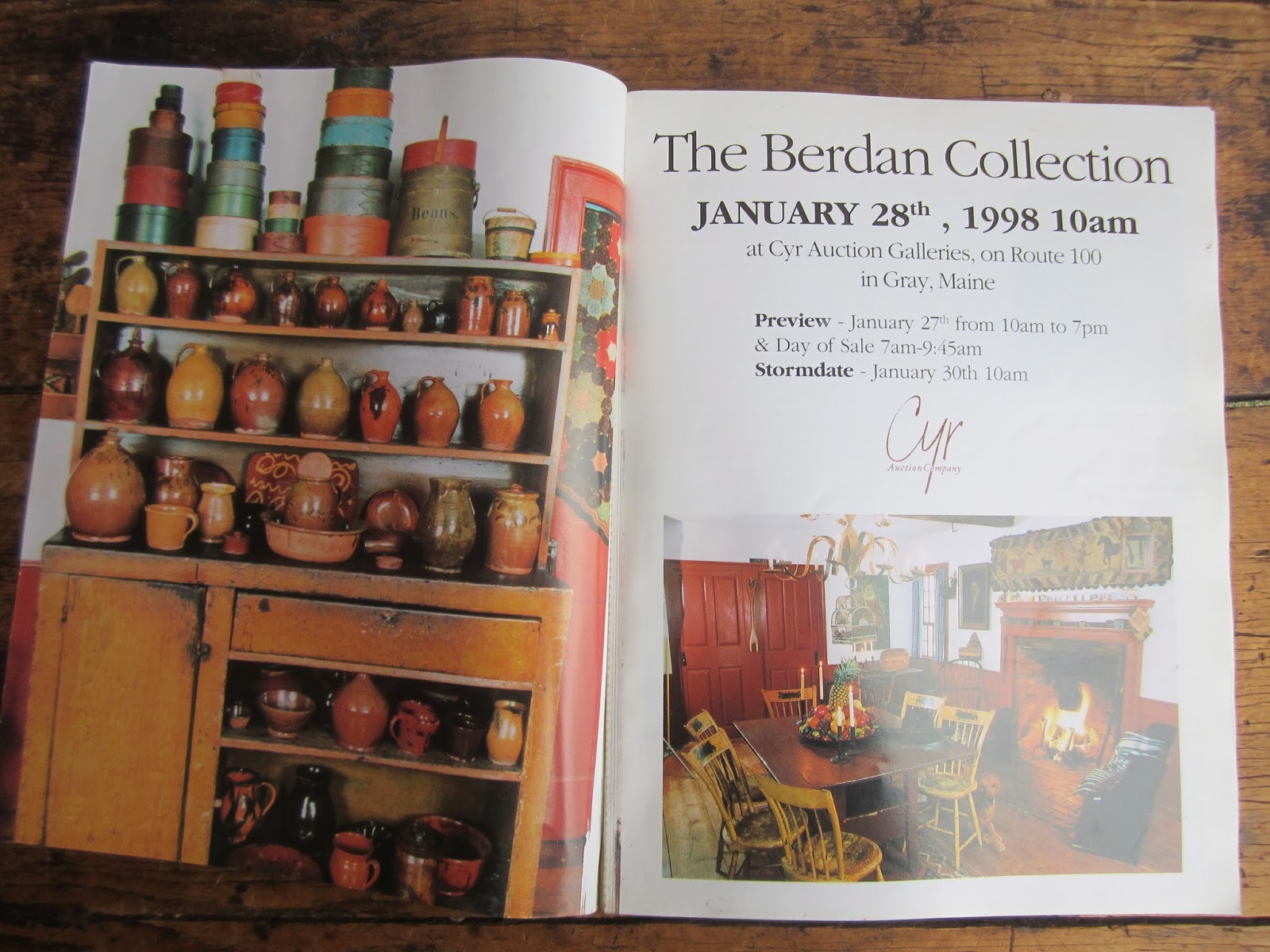


            I looked around for a mantel and its canary.  To show you.  I found something that does.  From a well regarded Maine dealer and collector’ collection sale I find nearly satisfactory demonstration of ‘Canary’ in the (old) New England (Maine) home... collected (and here sold) in the (old school) New England way.
            The whole collection was a superior lifetime gathering of classic Maine and New England decorative arts (antiques).  Positioned with little notice I find three examples of hand painted canary lustre ‘soft paste’; three on the ‘mantle pieces’.  The three specimens ARE photographed on the mantel AND are posed on that mantel off center.  The qualifier is that this is a ‘posed’ for the catalog.  They are, and should be noted, correct as a posed.  This, oddly, shows how deep the etiquette is for it is a subconscious ‘default’ pose that IS the correct pose for the ‘those that know’’ and... THAT is the those this catalog and collection sale ‘is for’ (directed at).  So.... it gets there (off center on the mantel) the long way around...
            And is supported by the collection itself.  What that means is that a curious dark edge of Canary-on-the-mantel... is that the (old school) (very knowledgeable) dealer – collector has... in fact... very little ‘other (antique) china’ in their hoard.   That is right:  Very little else.  The best (easiest) notice of this is that there is, in most cases, ...no... “dark blue” (deep blue English Staffordshire earthenware pictorial or historical transferware).  Most all ‘antiques collectors’ agree that the ‘dark blue’ is of ‘keeper’ grade merit for one’s hoard.
            Of notice is that the Canary-on-the-mantel crowd maintain a ‘step beyond’ poise that is a feeling... “correct” (I agree)... that their ‘Canary’ ‘one piece’ on the mantel, explains fully their understanding of old china in an old New England antiquarian’s hoard to the “anyone” who ‘does know’.  And:  That these in-the-know... be the only ones who ‘need know’... where an antiquarian’s old New England home’s collection
            Is at:
            One .... piece of true hand painted Canary DOES say it all about one... and all... old china... in old New England and its homes.
            It is just fine to not agree.  WE... (I too)... don’t care what you feel... let alone ‘think’.


            Back within the catalog, the three lots are photographed ‘close up’ too and... they sell (each) for ‘a lot’ ($400 plus each).  They sell to like minded collector – dealers ‘who know’... too.  Never have I seen a lay person’s bid card ‘held up’ for ‘old canary’.  No... the stuff (Canary lustre) always... only... sells ...to the ‘they know’.  And shown in this catalog.. is all of that at work.  That includes my further notice that most.... MOST... of the Those People who I would consider adept at participation in this sale would, too, NOT HAVE NOTICED “the Canary”.  Do not fear:  It WAS noticed. 
For this ‘most’ ‘participation’ group that I speak of, their principal contribution to “Canary” is to always acknowledge ‘it’ and, most often, express that it... is a “IT... SELLS FOR A LOT”.  But:  They... never... ever... “owned a piece”.
            So they are, although “good” antiquarians
            A rung or three DOWN
            On the ladder of the
            “old New England”.


            That should be the nasty part:  Simple snotty antiquarians having a superior aura because they have a single old beat up yellow sugar bowl on the far end of their Colonial fireplace mantel that is never mentioned, never talked about, noticed, touched, dusted or washed “ever” for ...the  half century of their ownership.  I have spent my fifty years pursuing Canary Lustre without ever talking about it to anyone.  I, too, ‘have found it’.  The sale collection’s three piece gathering is ...just about right... for what one may chance to find (three pieces) in one’s life time as an  (New England) antiquarian.  I have found a little more... but... not much
            The stuff is... rare.
            That gives us three points for confusion.


            The first point is that being rare... one has a hard time finding a specimen to “buy”.  With a finding ratio of three pieces to fifty years one may ‘take the hint’.  Finally... and usually suddenly... one finds a specimen, buys it and so... has one.  “There”.  “Finally”.  Take it home and put it on the mantel.  Off to the side.  No one notices it.  It is twelve months before someone does and comments but THAT PERSON has been ‘in the trade’ longer than you have and is... “very knowledgeable”.  THAT becomes point of confusion point two.
            YOU... have... NOT ever... “ahhhh....” compared “a piece” with another “a piece”... that YOU... OR ANY ONE ELSE... “HAS”... including color photographs in old auction catalogs (Part One).  TOO.  NO... you have not.
            That deceptive minor (?) issue WILL bite one’s buttock if one... is too ‘sure’ of self with the ‘I FOUND ONE’ canary.  This is because the “quality” of the decoration on the yellow ground... “ahhhh....” “varies”.  Simply, some are more vibrant and radically decorated than others.  Meaning some have (much) “MORE” decoration “better done” (more radical and vibrant).  You... do not know this... until... you see this with your eyes yourself:  YOU learn by seeing it (the variation of radical / vibrant decoration).  In stupid lay terms this means the more wild (accomplished) the decoration the MORE MONEY IT’S WORTH.
            So.... ‘knowing this’ is.. “crucial” commercially and... art wise personally (“My Preference”).   And again:  Your not gonna know this until you know... you have seen this.


            Further confusing this second point of confusion is the need to understand how this decoration that is “more wild”... is “accomplished”.  It is a backward and redundant process that the collector must absorb to understand what one is looking for as better-best radical/vibrant decoration.  Understand then:
            These ...mold cast and yellow ground “blanks” were hand paint decorated... in a similar ‘ritualized’ decoration... by a woman painting it on ‘them’... all day long, forever, among other women doing the same.  So... one may expect ‘variation’ in ‘qualities’ on ALL decoration.  Starting with ‘skill’ and ‘ability’... one opens the door to variation.  Next come mood, care, interest.  These go to day, weather, time.  Then on to interactions and interruptions (“the toilet” too).  Quickly one denotes... quite a stew... I’ve just made and it (all of this) is being expressed in the application of paint from a single tiny brush... by one single woman... “NOW”.  When done...
            The next one
            Is begun.


            So... for example... a good painter... (“very good”) may well work the decoration of a single ‘waste bowl’ for a ‘longer time’ because she... wants to ‘finish’ just at lunch time.  Meanwhile the eight year old “new girl” beside her ‘can barely paint’... yet.  There is the simple source of variation.  WHOSE decoration is the more “wild” when examined TWO HUNDRED YEARS LATER?
            This is not at all hard to note and notice... once one knows to do this.  It also brings us to the
            Need to examine
            NOT HAND PAINTED
            Decorated ‘canary’:
            The ‘decorated by transfer’...:  The third point of confusion... on the mantel


Wednesday, November 4, 2015

Canary Lustre - Part One - "One Piece... Off to the Side"


Canary Lustre

Part One

"One Piece... Off to the Side"


            In December of 1970 I purchased a lot at public auction from Sotheby’s in New York City.  The lot was sophisticated and the auction was sophisticated so I must have been sophisticated.  The printed pictorial catalog for the auction was sophisticated too.
            I purchased the lot.  Then I sold the lot.  I used the catalog.  Then kept the catalog
            Around.
            For years.
            Every now and then I’d ‘thumb through’.  Then... every now and then... I’d “should throw out”.  Eventually I had a meeting with myself and
            Deduced that ‘throwing out’ was a ‘could be done’ IF I tore out a
            Single page picturing nine lots in color.  These lots had nothing to do in any way with the lot I had purchased and sold.  I never had any inclination to “bid” on those lots.  My relationship was... and still is... founded solely on my personal attraction to the nine lots pictured in the catalog’s color plate.  I tore out the color plate and have kept it ever since.  I long ago threw the catalog out.


            What ever happens to an antiquarian someone as they ramble along within ‘the antique interest’, they will always, over and over, ‘desire’ to ‘acquire’: ‘Acquire’ a  ...“what ever”... ‘over and over’... due to... ‘desire’.  Most of this is blurry and confused with no particular skill shown to one being ‘at this’.  Talking about or speaking of this is, too, for the most part, ‘weak’...
            ....In gaining an actual sense of the... blurry and confused... depth of the... ‘desire’ to ‘acquire’.


            This “I tore out” color plate is about that.  I have never talked about it or spoke of this... ever... before now... to any one at all for any reason.  This is because it is perfectly obvious to me why I retained this catalog plate and ...I do not need any sort of ‘elaborate further’ ...at all.


            Even for a “You?”.
            Today, I will?
            Why don’t we agree that I will “try”
            To “try”.


            If I cared about the torn out plate’s contents in 1970, then I must have developed a reason for my attention-to-care.  Right?  I must have had a ‘care’ before discovering the auction lot color plate.  I did not just “OH MY!”.  No... I must have “knew about”
            “That”.
            When?  How?  But first... about “What?”
            Is that:
            Nine pieces of
            “What?”.


            It is, when I first heard (hear a someone call that something specifically saying a title of “What?”):  They said “Canary Luster”.  Or was it “Lustre”.  YOU know how people are about words like that.  Right?   Affected.  Or effected?  Anyway.  Some said something and I heard it.  It was an old person.  I know that because I was a young person.  I was in Junior High School (Middle School).  I was not doing a project for school.  I was...  then... buying and selling what I discerned to be “antiques”...
            With that frontier edge of art-world-view-I... expanding daily as I listened to what I heard... from old people.


            In this particular case I was tagging along and had ‘been brought too’ to a private home of what I came to understand very clearly over several decades... was the home of a “DEALER” who is “very knowledgeable”.  I... did not have to say much and was ‘just stand there’ and this allowed me to ‘look around’ and I did that ...obsessively... for the home was very... very full of ‘real antiques’.  I... could see that.  As I cared for real antiques myself I was ‘fine’ with obsessive looking ...around.


            Now... Colonial New England (coastal Maine) homes were ...at that time... “something” I found myself “going in” more... and more.  And I did not refine that occurrence myself.  No.  I just was ever more “in them” (coastal Colonial Maine homes).  And it was ritualized to all be sort of a same.  I would ‘go in’ and, with the visiting party... AND the head of the home (usually an ‘old person... woman’) we ‘centered’ around the large Colonial fireplace resplendent with... every Colonial Maine “antique fireplace” object the head of home had gathered “DISPLAYED” there with an “ARRANGED” too and... well... a subliminal... “do not touch” ...too.  So I looked around and didn’t touch.  There was plenty to look at in these ...classic ‘old school’ “Maine” “antiques dealer’s” “homes”.


            So...:  On this particular I stood my look around and in the course of that I looked at the contents of the fireplace mantel shelf above the fireplace.  Carefully.  “Carefully” is because I already... in Junior High School... understood that THAT; the mantel shelf ‘stuff on it’ was... IN THIS WORLD (coastal Maine antiques dealer’s home) a sort of laid bare naked IN YOUR FACE statement about “What I know”.  And that was a ...”THAT”.  The mantel contents was... and... still... is... a billboard sign of “WHAT” “I KNOW”... selected and arranged.  Again:  It is THAT.
            Do not forget this
            Do not mistake this
            Do not FAKE THIS
            Do not make an ass out of yourself by going giddy-goo over ‘someone’s mantel’.
            THEY will know who the giddy-goo IS.  And you will not.  Shut... up... and... LOOK.


            There are all kinds of mystical mystic in a ‘good’ mantel display by a ‘she is very knowledgeable’ dealer.  One may write for pages about each and every... thing on the damn mantel.  My (antiquarian-art) eye rakes mantels in micro seconds... these days and for decades.  No problem with that precious antiquarian territory do I have.  Today... I am writing about only ONE of objects found on this sort of mantel.  ONE... THING:  “Canary Lustre”.
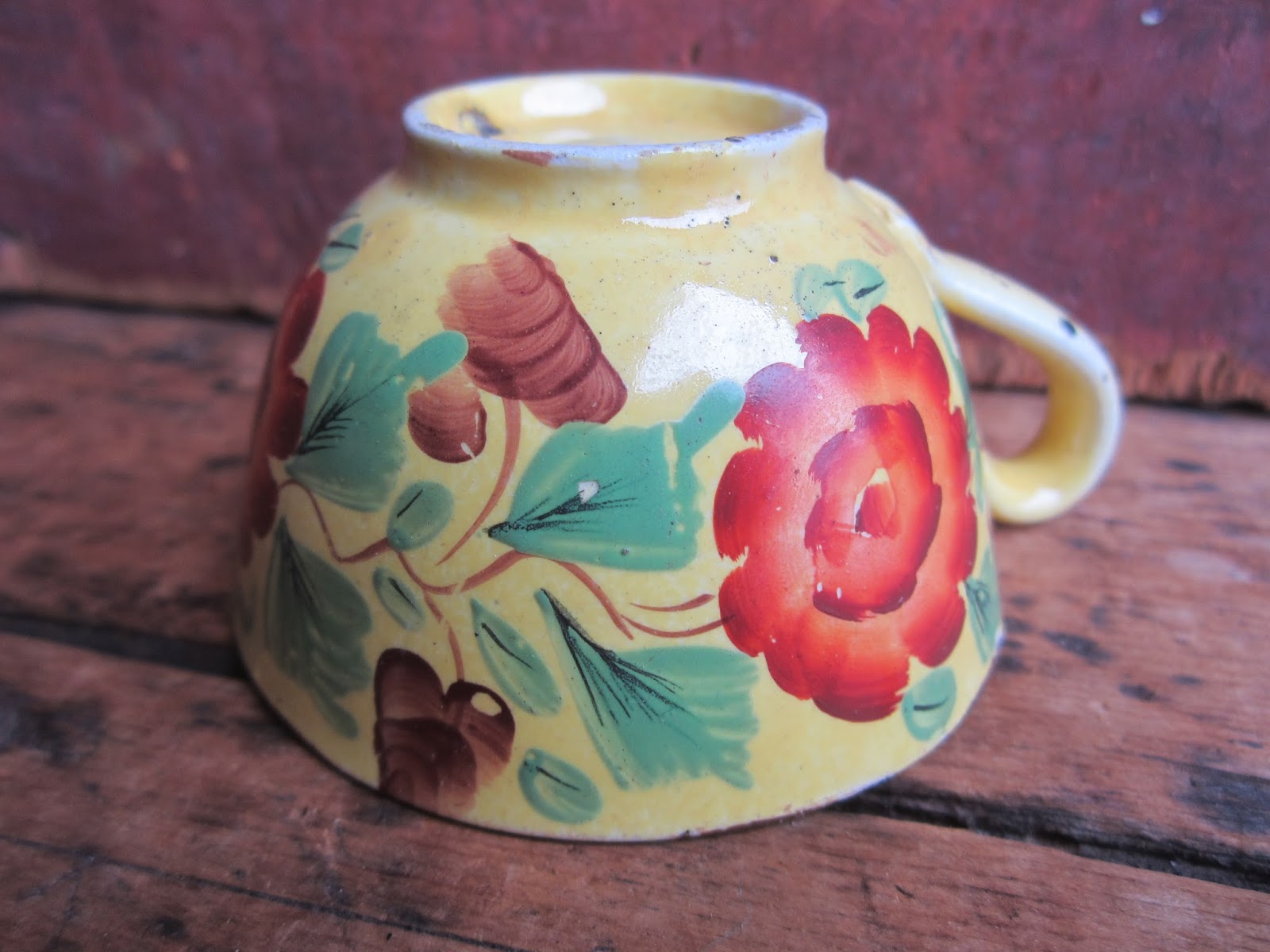
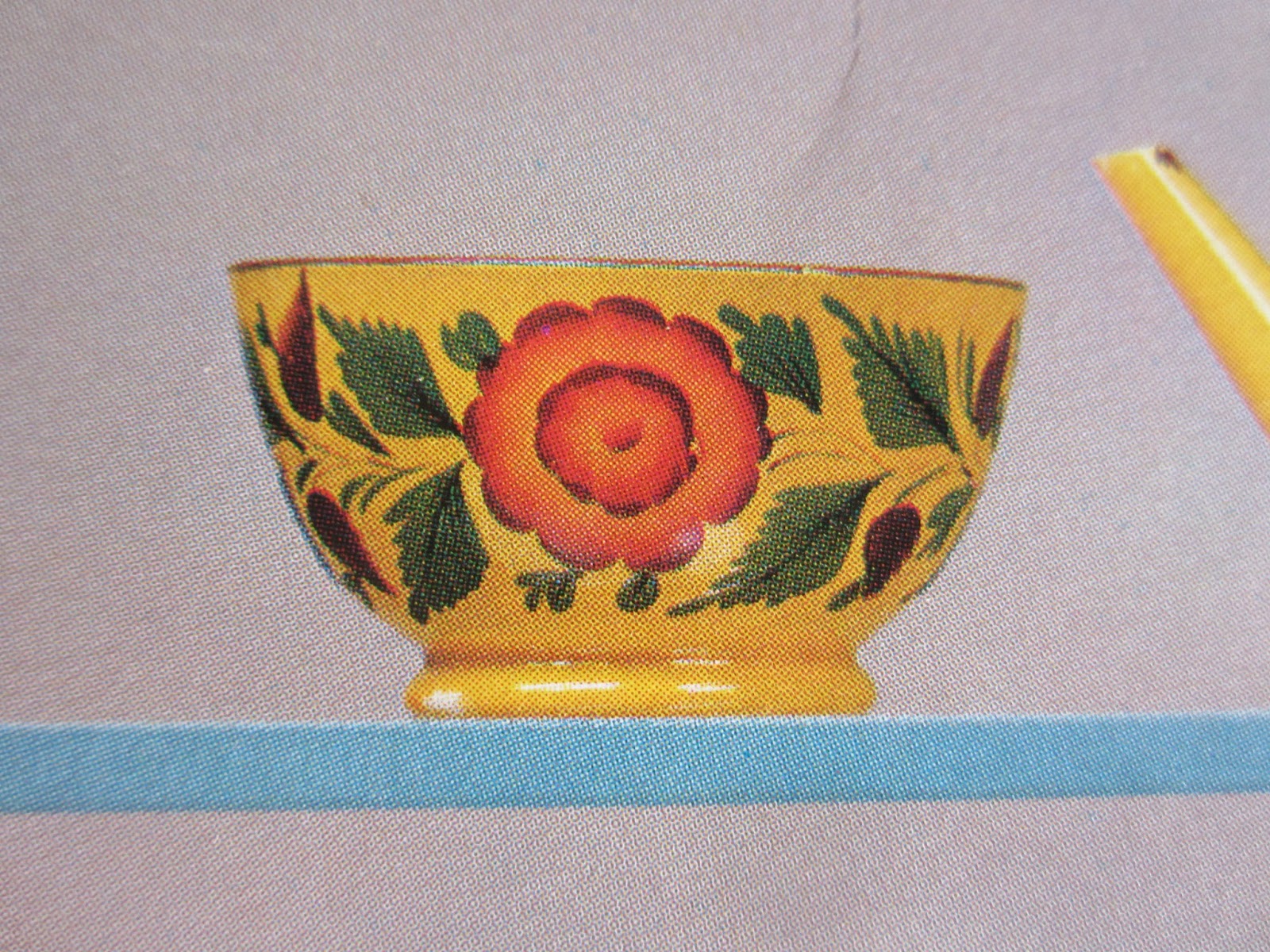
            What that is ...as I stood in Junior High School awe... is that there...; that woman there... on her mantel... had a... VERY BRIGHT yellow... ‘piece of old china’ that was, too, vibrantly hand paint decorated in green, brown and red stylized flowers and vine... decoration UPON this yellow ground AND had rust-red hand painted ‘banding’ too.  Now... right here... I must denote that the “lustre or luster’ issue is compromised here at this rust-red banding because “luster / lustre” is either ‘silver’ or ‘pink’ banding; shiny silver and pink.  THIS rust-red banding is not shiny so is... not ...lustre / luster.  A MISS TITLE... thus.  Remember that and complacently accept that as a classic ‘old school’ “mistake”.  Then... learn to love calling it that yourself.


            Anyway:  Bright Yellow Something on the old woman’s mantel... I SAW.  That day.  I did not know what it was (other than being “OLD” ‘china’).  I did not ask or say anything.  Remember that:  Canary Lustre generally is never... ever... talked about.
            Asked about
            Or “shown”.
            I ‘dumbed’ my way but my antiquarian eye was ‘changed forever’.  In two ways.  (1) I had ‘seen’ my ‘first piece’ “of Canary” and (2) I had seen it
            Correctly
            Displayed.
            (A single piece on a Colonial New England fireplace mantel).
            When it comes to ‘old china’ in ‘old New England homes’ the this of what I just described is the ultimate ‘up yours bitch’ ‘old Wasp’ declaration of ...
            WHAT?
            One may have no other china... old china... any china... ANYWHERE EVER ANYWHERE ...AT ALL... EVER... ANY... WHERE... but if one has a single... relic grade fragment of “Canary” on ones mantel.
            Sweetheart... you do not have to worry about a thing.


            I restate again for clarity.  I saw my first piece of HAND PAINT DECORATED (as opposed to transfer [ware] decorated) bright yellow ground “Canary” English “soft paste” ‘china’ and noted too that it was displayed as a single stand alone ‘piece of old china’ on a fireplace mantel in a coastal Colonial Maine home and that... would become my absolute understanding that THAT is the classic correct way (old New England Wasp way)... ‘to display’.  And one more note on that:  NEVER... IN... THE... CENTER (of the mantel).  Always ‘off to the side’ (right or left) ‘on the mantel’.  ALWAYS!


Monday, November 2, 2015

Smocking Sugar: The Divided Diamond of New England


Smocking Sugar:

The Divided Diamond of New England


            “Is the Smocking”:  “Another early design in early flint glass seldom seen outside of New England is the Smocking”.  This is Ruth Webb Lee in her SANDWICH GLASS, Lee Publications, Wellesley Hill, Mass, 1966, page 510.
            Yes... I say.  Just look that over again noticing the phrase ‘is the Smocking’, the capitalization of the S of Smocking, the ‘seldom seen outside of New England’ and....
            The ‘she is queen’ Ruth Webb Lee... is... publishing, didn’t she, “there” (Wellesley Hills).  She is queen of what?  EAPG (Early American Pressed Glass). 
She continues with another sentence:  “The footed pieces in the Smocking are all scalloped, which is an indication of its early age, for scalloped feet are seldom seen in pressed glass though frequently on blown (New England glassware)”.  Her middle sentence, dividing the two quoted, is “The goblet is particularly scarce”.  One may bank that insight.


            Lee does not include or mention “Smocking” in her EARLY AMERICAN PRESSED GLASS book (Northboro, Mass, 1946).  That is right:  She does not.  Remarkable... actually?
            Actually not:  It (‘the Smocking’ glassware) is... too... early?
            She does include it in her VICTORIAN GLASS.  Page 69 and Plate 25 (Northboro, Mass, 1946).  Skimpy treatment there but I notice a ‘she says’; “appears to be of only New England ancestry”. 
In the plate she illustrated ‘the sugar’.
            “Oh.”
            “So what.”


            That’s the way I was with it (“is the Smocking”) for twenty-five years; from when I was born and then raised in old New England decorative arts... found in old New England homes.  A quarter century of being born and raised.  Yes... didn’t I just... “found” those... old glass sugar bowls that “is the Smocking”.
            Yes:  Didn’t I just.
            I remember very long ago... being in an old, old house and... it (the sugar bowl) is... there... very clearly old glassware to even... well... I DO suppose one needs a “SHOW ME”... but not too much of one:  It IS old... especially when there is ‘nothing else around’ ‘like it’.  So I found that... there... that day:  A sugar bowl that “is the Smocking”.
            I had it home.  And looked at it.  A little beat up... from actual usage.  They all are; always are.  Make note of that.  Then I set it to sell.  No one ever asked.  To buy.
            Ever.


            After it had ‘set’ for so long that I had found another one ‘too’; they then ‘set’ together... I “gave up” (trying to sell them) and “put them away”.  They were both WONDERFUL early American glassware; ‘obviously old’ flint glass bell tone ring. Etcetera.  So I didn’t just and ... I didn’t know... or care to know... the “is the Smocking”
No.  I just ‘put them away’.
            Soon... I found a third... sugar bowl... that ‘is the Smocking’ in... another... old New England home.  I really had quite a collection of... something that nobody buys and nobody knows about.  Forty-five years later... I’ve found ‘a hundred’ of them?  No.  Certainly twenty-five.  Certainly thirty-five.  Probably forty-five... if I include the odd lids and odd bottoms... too.  “Certainly forty-five.” I say.


            They are all the same too.  They all look alike.  They are all “always” beat up.  From actual usage.  Many still have sugar in them.  The sugar is protected ‘under the glass’ (lid).  White sugar mostly.  Brown sugar sometimes.  That’s older.  Of course you know that.  Hardened.  All of it.  I used to clean the sugar out.  Now I never touch it.  The old sugar stuck in the old New England glassware sugar bowl... is beautiful... to my eye.  The sugar bowl... “is the Smocking”.  To my eye.  I know that now.  Have for years.  I’ve never found them anywhere except in old New England homes.


            I found one in an estate in Sherburne, Mass.  One in a home on Martha’s Vineyard.  TWO (“a pair”) off of Route Seven below Bennington, Vermont.  One in Orford, New Hampshire.  One in Lisbon, New Hampshire.  And in Maine?  Certainly several dozen.  They are all over the place... in old New England homes.  Always popping up.  They are.  I always get them.  No one wants them.  No one knows anything about them.  I won’t even touch the ‘is the Smocking’.


            Yet at the same time... I have the same bad people... so sure that they ‘have’ and ‘know’ “New England”.  They don’t.  They have never ever even spooned brown sugar from an “ANY” sugar bowl.  “Loaf sugar WHAT?”.   And that is that:
            Where they are at.
            It has become obsessively clear to me that these ‘is the Smocking’ sugar bowls were... one of... (your?) great... great... great... (1830-40) grandmother’s (PROBABLY) first ‘tableware’ ‘glassware’ in her home.  Peddler peddling “them” (“is the Smocking” sugar bowls) (they are rugged little jewels so traveled well).  He did not call them “Smocking”.  That is a we-now-us-may.  She (g-g-g grandmother) ‘liked it’.  That’s it.  Then she bartered (for) ‘it’ and insided it and filled it and tabled it and it ... it... it... for, okay... forty years... until her grandchild... ‘put it away’... “after she died”... ‘in the cupboard’ where it stayed undisturbed until I
            “Cleaned it out”.


            Every one of the bad people are always telling me about the ‘old New England’.  They are.  And that includes the drapes, the chairs, the china, the shoes, the lawn, the fountain, the horses, the cars, the “Take Ivy”, the “President C-E-O” crap and the “GENE POOL” (DNA).  Today... with the ‘is the Smocking’, I speak of old pasture gates beside the barn and the old Maple trees
            Along the road
            Before the farm.
            “I didn’t know that”
            “Is the Smocking”
            “Too.”
            I always pick them (the ‘is the Smocking’ sugar bowls) up when I find them ‘going by’.
            George and Helen McKearin notice “Smocking” with a single specimen; pg. 397 for Plate 207, #3, AMERICAN GLASS, Crown, New York, 1941.
            Sometimes Smocking is called ‘Divided Diamond’ but ‘Smocking’ is ‘old school’
            New England.  So what.


            If I hate you and love the sugar bowl... does that make sense to you.  No it doesn’t does it.  Mr. and Mrs. Commercial Lie.  The middle name is New England:  Mr. and Mrs. Commercial New England Lie.  That is a gene pool.


            The commercial lie.  There is no commercial antiquarian market at all for an old smocking sugar bowl.  I have never had anyone ever speak to me (“inquire”) about the glass sugar bowl, the New England glassware sugar bowls or an ‘is the Smocking’ sugar bowl.  I have ‘offered’ (had for sale) ‘is the Smocking’ sugar bowl(s) for fifty years and no one has ever purchased one.  Looked at one.  Picked one up.  “Inquired”.  Shown any knowledge of.  Or.  Even acknowledged that any ‘is the Smocking’ sugar bowl is ‘even there’.


            Collectors ignore; “too common”.  At the least?  Or at the best?  Thrift shops put a dollar on the lid and a dollar on the bottom.  Often times they are two isles apart.  I have helped numerous ‘get back together’.  They were nearly separated by ignorance (idiots) after at least one hundred and fifty years together.  “Nice of you to do that”
            You say.
            From the empires and islands of vanity of the new New England.  The island is the box store.  The empire is the parking lot.  You have such good taste.  I hate you and
            Love the sugar bowl.
            Don’t I.


            What if I was in an... old New England home and... they said... they are “keeping that” and continued by saying “it is a New England glassware sugar bowl.  It’s pattern...
            “Is the Smocking”.
            “It is”, continuing, “one of the... if not the... earliest pressed glass sugar bowls ever made.  It was designed and created... molded and manufactured... in New England.  The first and only place in the world to do this”... with this... ‘is the Smocking’ ...glass ...sugar... bowl.  “It was made no where else.  Ever.  It is beautiful and we love it.  We have used it in our family for one hundred and seventy-five years.”
            What if they said that?


            To me?
            I would be startled and very curious to know how much deeper their cultural sense of heritage and history of old New England is:  “If they know that”...
            “What else do they know?”